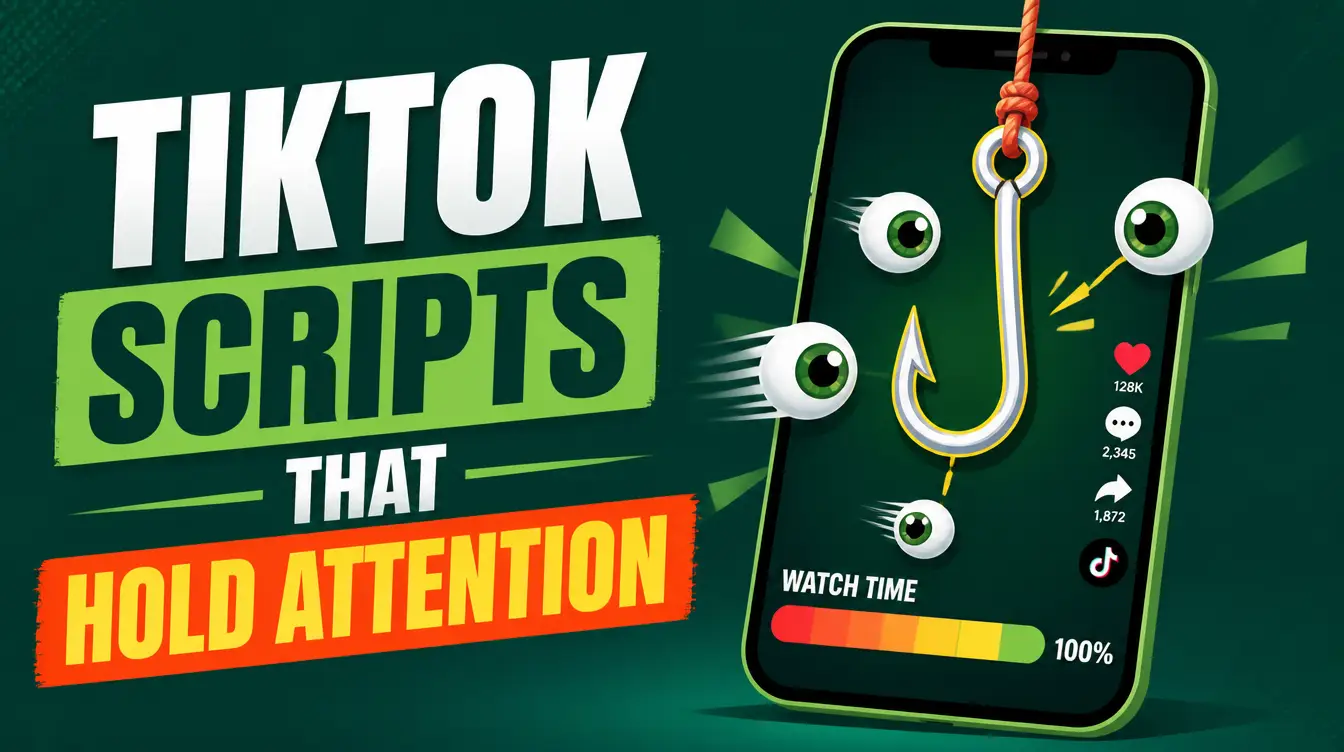
TikTok does not reward the best video; it rewards the video people finish. That is a writing problem before it is a filming problem — the first two seconds decide the scroll, and the structure of the next thirty decides whether the algorithm shows it to anyone else. Writing TikTok scripts with AI works when the AI is given a completion-rate structure instead of a vibe, and that is exactly what the Anti-AI-Slop Content Creator skill brings: it tunes scripts for TikTok and Reels completion-rate structure specifically, bans the filler vocabulary viewers have learned to smell, and refuses the fake enthusiasm that kills retention. This guide walks the script-writing method, hook to CTA, with the free skill doing the structural work.
The model, if it is new to you: a skill is a bundle of instructions that teaches an AI agent like Manus or Claude a complete methodology. Two minutes on what an AI skill is, then into the script.
What separates a finished TikTok from a scrolled one?
The retention curve, and every script decision either bends it up or breaks it. The structure that bends it up is known, teachable, and boring: name the payoff in the first line, pay it off progressively, and never let a sentence exist that could be cut without losing information. The table below is the whole game:
| Script moment | What kills retention | What the skill does instead |
|---|---|---|
| First 2 seconds | "Hey guys, today we're going to talk about..." | Opens with the payoff or the contradiction — the reason to stay, stated immediately |
| Seconds 3–15 | Setup that belongs in the description | Progressive payoff — every line delivers something new |
| The middle | Rule-of-three padding and symmetric filler | Cuts filler cadence and manufactured enthusiasm outright |
| The ending | Trailing off, no CTA | A clean close that earns the loop or the follow |
How does the skill write for completion rate?
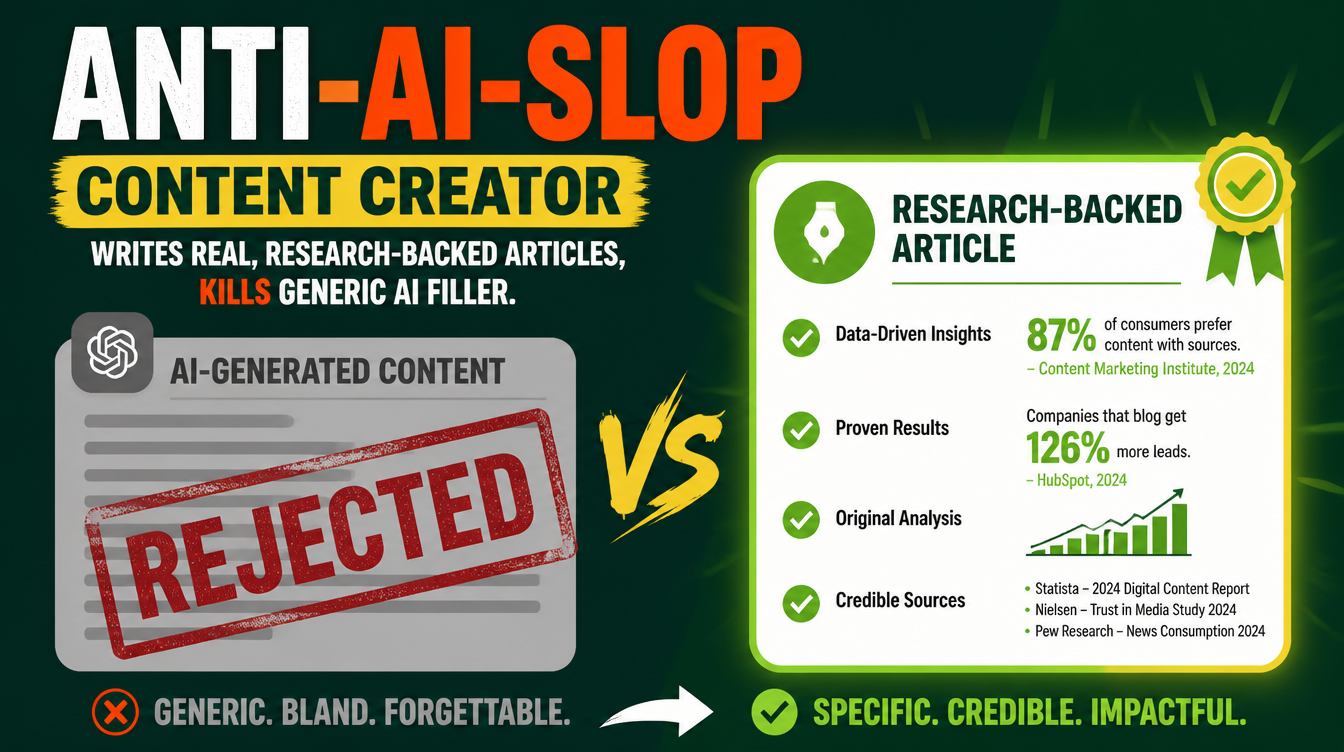
The Anti-AI-Slop Content Creator is a research-backed content strategist that runs a seven-step pipeline — intake interview, live niche research, topical-cluster content plan, writing, self-review, visuals, and platform tuning. For TikTok the platform-tuning layer is explicit: it structures scripts for completion rate, the metric that decides distribution. Two of its rules do most of the work on short-form. First, the vocabulary ban: words like "game-changer," "elevate," "unlock," and the manufactured enthusiasm that accompanies them are banned outright, because viewers parse them as an ad within one second and scroll. Second, the replacement test applied to every sentence: if any creator could have said the sentence about any product, the sentence is rewritten until only you could have said it about your topic. In short-form, where every second is a chance to leave, generic writing is not a style problem — it is a retention leak.
Where do the ideas come from?
The same skill's research layer. Its pipeline starts with live niche research before any writing happens — what is actually being asked, what the competitors' successful clips do, where the gaps are — and builds a topical-cluster content plan rather than a list of one-off ideas. That is the difference between an account with themes the algorithm can learn and an account posting random clips hoping one lands. The planning method is unpacked in the anti-slop writing guide, and the same skill's discipline applies to every platform you repurpose to.
Nobody finishes a video because it was well-filmed. They finish it because the next second always seemed worth one more second — and that is a script property, not a camera property.
How do you write a TikTok script with the skill, step by step?
- Run the intake interview: topic, audience, the one thing viewers should walk away with, and the format constraints — length, on-camera or voiceover.
- Let the research layer run on your niche before writing: what the audience asks, what competing clips do, where the gap your clip should fill is.
- Draft the hook first: the payoff or contradiction in one line, no greeting, no setup — the skill's rules forbid the throat-clearing open.
- Build the body as a progressive payoff: every line delivers something new, and the replacement test kills any line a generic creator could have written.
- Run the self-review checklist on the draft — the skill's built-in pass that hunts filler cadence, symmetry padding, and enthusiasm that reads fake.
- Write the CTA as a clean close, then repurpose: the same structure feeds your Reels, Shorts, and the YouTube version — the packaging for which is covered by the YouTube SEO skill guide.
Does this work for Arabic TikTok?
The methodology is language-agnostic, and for Arabic specifically there is a dedicated sibling skill — the Arabic Anti-AI-Slop Content Creator — built for the Arabic web rather than translated into it. It hunts the ten Arabic slop tells, including rhyming with no function, translated-language constructions, and mechanical symmetry in section lengths, and it tunes for Arabic platforms explicitly. If your audience scrolls in Arabic, that is the version to run; see the Arabic anti-slop skill guide. Creators building a wider operation will find the full stack in the AI skills for content creators guide.
FAQs
Can AI write TikTok scripts that people finish watching?
Yes, when the AI is given completion-rate structure instead of a topic summary. The Anti-AI-Slop skill tunes scripts for TikTok's completion-rate structure specifically — payoff-first hooks, progressive delivery, and no filler vocabulary that viewers parse as an ad.
What makes a good TikTok hook?
A hook states the payoff or the contradiction in the first line — no greeting, no setup, no "today we'll talk about." The skill's rules forbid the throat-clearing open because the first two seconds are where the scroll decision happens.
Is the skill free?
Yes — the Anti-AI-Slop Content Creator is free on Mahara AI, and its Arabic sibling is free too. Paid skills on the platform start at 499 EGP (about $10 USD), there is a 499 EGP per month claim-and-keep subscription, and every purchase carries a 7-day refund.
Does this work for Reels and Shorts too?
Yes — the platform-tuning layer adjusts the structure per platform, and the same script skeleton feeds Reels and Shorts with minor edits. For the YouTube version, the YouTube SEO skill packages the title, description, and tags.
How is this different from asking ChatGPT for a script?
Discipline. A general chat request returns a generic script with the exact filler cadence and enthusiasm that kills retention. The skill runs a research layer first, applies the vocabulary ban and the replacement test to every sentence, and self-reviews the draft before delivery.
Your next video is one script away from watchable to finishable. Download the skill, write the hook first, and post the version that respects the viewer's seconds.