Most content written with AI in 2026 does not fail because a model wrote it. It fails because it could have been written by anyone — and both Google and ChatGPT have learned to skip text that carries no sign of the person behind it. This is the workflow we use to write content with AI without slop: a five-step process that treats the model as an intern, a 12-point checklist that catches machine-writing tells, and the skill that runs the whole pipeline for you.
By the end you will know why invisible AI content stopped ranking, how to keep the experience signal that ranking now demands, and how to structure a page so an answer engine lifts your paragraphs whole.
What is AI slop?
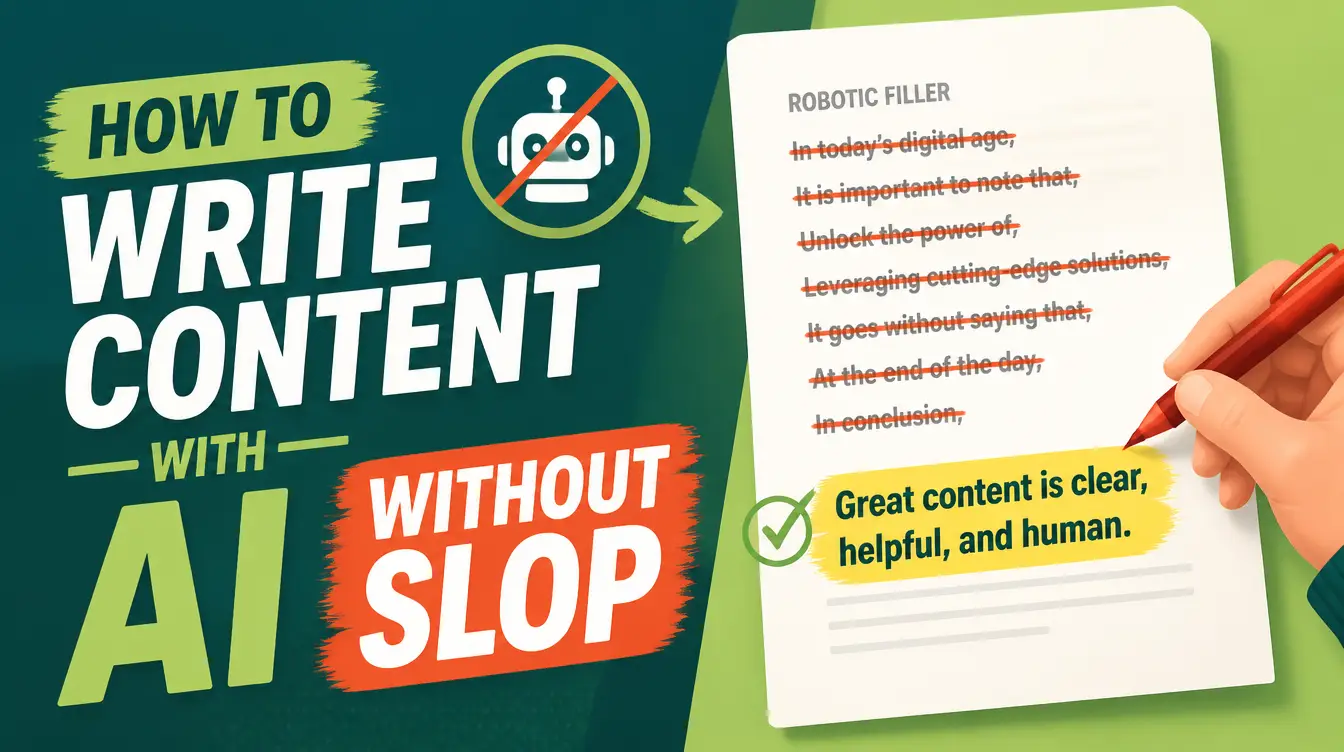
AI slop is machine-generated text that reads clean and says nothing: grammatically correct, factually empty, interchangeable with ten thousand other pages. It always shows the same three tells.
- A narrow, predictable vocabulary — every paragraph sounds like the last one.
- Uniform sentence rhythm — humans mix long and short; machines pace evenly.
- No authentic voice — no personal stake, no specific detail, no opinion the writer earned.
Here is the fastest test. Replace your name with any other writer's name. If nothing changes, the article has no experience signal — and experience is exactly what Google's Helpful Content System and the AI answer engines score hardest today.
Why did unedited AI content stop ranking?
Because the web flooded and the filters adapted. AI Overviews now appear in roughly 16% of Google searches — far more on comparison and how-to queries — and an estimated 40–60% of the sources they cite change month to month. That churn is your opening: when a competitor's citation drops, a genuinely useful, well-structured article takes its place. Slop never gets that call-up, because it is indistinguishable from the next page.
Which two ranking games are you playing?
You are playing two visibility games at once, and one article has to win both.
| Game | What it rewards | Where it shows up |
|---|---|---|
| SEO | First-hand experience, topical depth, technical quality | Google blue links |
| AEO / GEO | Self-contained passages, clear entity identity, brand mentions across the web | AI Overviews, ChatGPT, Perplexity, Copilot |
The two games overlap more than they differ, and one principle serves both. For the full map, read SEO vs AEO, then AEO for skill creators.
Write what a real expert would write, for a reader with a specific need — and make it structurally legible to both humans and machines.
What is the five-step workflow?
Treat AI as an intern, not an author. The intern drafts; you own the argument.
- Pick a query a human would actually search, and match the format to the intent — a comparison query needs a comparison page, not a generic guide.
- Bring something the model does not have: a result you measured, a case study, a first-hand observation, an opinion the consensus does not hold.
- Let AI draft the structure only — headings and the question each section answers — never the prose.
- Write the 20% that matters in your own voice: the intro, the conclusion, and every paragraph carrying your original insight.
- Enrich for machines: descriptive headings, a self-contained FAQ, and Article plus FAQ schema that mirrors what is visibly on the page.
Step two is the highest-leverage move on the list, and it is the one everyone skips. The model already knows everything published. It does not know your numbers.
What are the 12 slop signals to kill before publishing?
Run every draft through this table. Every hit is a defect to fix, not a style choice.
| Signal | Slop looks like | The fix |
|---|---|---|
| Hedging | "may help," "can be beneficial" | Assert: X causes Y |
| Filler intros | "In today's fast-paced world" | Delete; start with the answer |
| Superlatives | "revolutionary," "game-changing" | Replace with a number or mechanism |
| No numbers | "strong ROI," "fast results" | Give the specific figure |
| Uniform rhythm | every sentence ~20 words | Vary length; go short, then long |
| Listicle verbs | "dive into," "leverage," "unlock" | Rewrite plainly |
| No first-hand detail | advice anyone could give | Add one experience only you have |
| Missing attribution | no author, no credentials | Author, bio, sameAs links |
| No stakes | agrees with everyone | Take a position and defend it |
| Keyword stuffing | same phrase in every header | Natural variations and synonyms |
| Repeated structure | five identical paragraphs after "5 reasons" | Vary the format; cut restatements |
| Padding for length | long because it repeats | Be long only to answer real sub-questions |
Two checks catch most slop in seconds: the name test above, and the reading test — read a paragraph aloud; if the rhythm is flat and nothing would be lost by deleting it, delete it.
How do you write so an AI can lift your paragraph whole?
Answer engines do not read pages; they extract passages and reassemble them into answers. The passages that get cited are self-contained and front-loaded.
- Front-load the answer — the point goes first, never after two sentences of setup.
- Make every paragraph self-contained — no "as mentioned above," no "this is why."
- Use concrete numbers — "salting eggplant for 15 minutes removes bitterness and excess moisture" is extractable; "there are several reasons this works" is not.
Descriptive headings are the other half: engines match headings to queries, so every H2 should state completely what the section covers. An explicit FAQ section remains the highest-citation structure across AI platforms — which is why these rules are baked into the creator stack we recommend.
Which AI skill runs this pipeline for you?
We packaged this workflow into the Anti-AI-Slop Content Creator skill. It runs a seven-step pipeline — intake interview, live niche research, topical-cluster content plan, article writing, self-review pass, visuals, and platform tuning — and it hunts the nine slop tells in every draft, from hollow claims and throat-clearing to rule-of-three cadence and manufactured enthusiasm. Slop vocabulary is banned outright, and the output is tuned per platform: Google, AEO, YouTube, TikTok, LinkedIn, and news.

The same honesty discipline applies beyond blog posts. The Professional Website Builder skill writes entire websites under explicit rules — real details only, no invented proof — and for video, the YouTube SEO skill package applies the same extractable-structure thinking to titles, chapters, and descriptions.

FAQs
Is it okay to publish AI-written content?
Yes. Google and the AI platforms do not penalize content for its origin — they penalize mass-produced text that adds nothing new. The difference is editorial: AI drafts the routine parts, and a person with genuine knowledge adds the experience, data, and voice.
What is the single biggest ranking difference in 2026?
Demonstrated first-hand experience. In a web flooded with grammatically clean AI summaries, a specific result, number, or case study only you could know is the clearest way to stand out.
How do I get cited in ChatGPT or AI Overviews?
Make your content technically accessible and crawlable, write self-contained front-loaded passages, use descriptive headings and Q&A structure, and build brand mentions across Reddit, LinkedIn, YouTube, and review sites.
Does content length still matter?
Not as a number. The right length is whatever it takes to genuinely answer every legitimate sub-question — no more. Length from repetition and padding actively hurts you.
What is the fastest SEO win on an existing blog?
Improve pages already ranking in positions 5–20 in Search Console. A sharper title or better answer there is almost always higher ROI than writing new posts from scratch.
The bar in 2026 is simple: publish AI-assisted work that could not have been written by anyone else. Browse the Mahara AI skills library, install the anti-slop skill, and put your own numbers into the next draft.