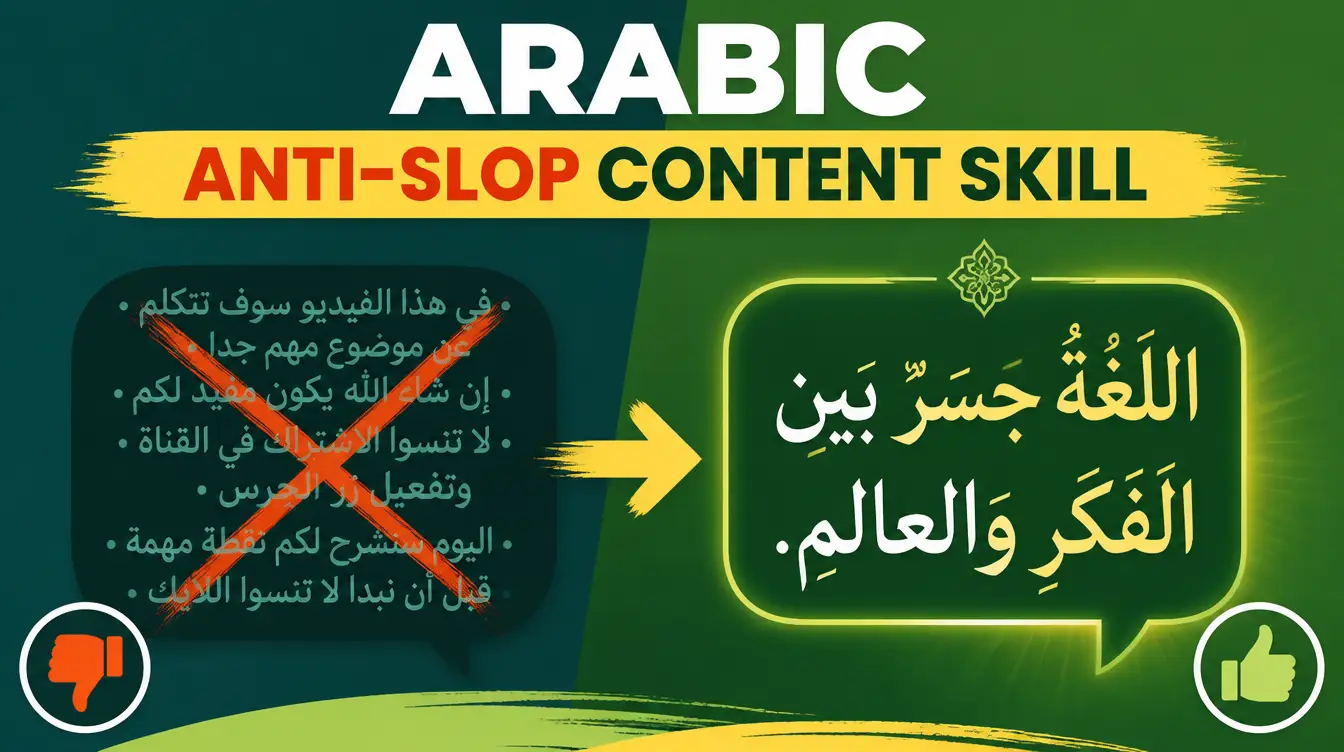
The Arabic web has a slop problem the English web never had: most machine-written Arabic does not merely say nothing — it sounds translated. The rhyming filler, the constructions no native writer would choose, the sections that all stretch to the same length. The Arabic Anti-Slop Content Creator skill was built for this exact problem: a content strategist skill designed for the Arabic web, not translated into it, that hunts ten Arabic slop tells and produces articles a knowledgeable Arabic reader would actually bookmark.
Why does Arabic AI content sound translated?
Because for most tools it is. The model drafts in an English-shaped mental space, then renders Arabic through it — and the seams show. You get functionless rhyming and ornamentation, the habit of balanced phrases that carry no meaning, and sentence structures copied from English grammar. A native reader feels it within two sentences, even when they cannot name it. That is the gap this skill exists to close.

Which slop tells are unique to Arabic?
The skill hunts ten tells — the same family the English edition kills, plus three that only exist in Arabic.
| Arabic-only tell | What it looks like | What the skill does |
|---|---|---|
| Functionless rhyming and ornamentation | السجع والزخرفة بلا وظيفة — paired phrases chosen for sound, not meaning | Strips ornamentation that carries no weight |
| Translated-language constructions | «هذا يسمح لك بأن»، «من المهم أن نلاحظ أن» — grammar no native writer chooses | Detects the translation tells and rephrases into original Arabic |
| Mechanical symmetry | Every section stretched to the same length regardless of content | Lets sections breathe at the length their substance earns |
Write Arabic that reads as if it was written in Arabic first. The reader can always tell — and so can the editor who quotes you.
What does the full pipeline look like?
- It interviews you first — your niche, your audience, the claim only you can make.
- It researches your niche live instead of assuming what already published articles said.
- It plans a topical cluster, so one article serves a strategy instead of standing alone.
- It writes the Arabic draft — original constructions, no translation rhythm.
- It runs the self-review pass against all ten tells before anything reaches you.
That last step is what separates a strategist from a generator: the draft is checked against the checklist the way a human editor would, and the same discipline governs the English edition described in our guide to writing with AI without slop.
Where does the output get tuned?
The skill adjusts the final text per platform: Google search, AEO answer engines, YouTube, TikTok, LinkedIn, and Arabic news sites — each rewards different structures, and the skill knows the difference. If you publish across platforms, this is the difference between one article dressed in six costumes and one article genuinely reshaped six times. The wider creator context is in the content creator stack, and if you also package skills yourself, pair it with AEO for skill creators.

FAQs
What are the ten Arabic slop tells?
The same family the English edition hunts — hollow claims, throat-clearing, fake structure — plus three that only exist in Arabic: functionless rhyming and ornamentation, translated-language constructions, and mechanical symmetry in section lengths.
Who is this skill for?
Anyone publishing Arabic that has to earn trust: content creators, brand editors, news writers, and agencies producing Arabic content plans and editorial calendars at volume.
Which platforms does it tune for?
Google, AEO answer engines, YouTube, TikTok, LinkedIn, and Arabic news sites — each output is reshaped for the platform it targets rather than republished identically.
How is it different from the English anti-slop skill?
It is built for the Arabic web, not translated into it. It catches Arabic-specific tells like «هذا يسمح لك بأن» and «من المهم أن نلاحظ أن», and writes Arabic that reads as originally Arabic — while covering the same full pipeline of interview, research, planning, writing, and self-review.
How much does it cost?
Some skills on Mahara AI are free, and paid skills start at 499 EGP (about $10). There is a 499 EGP per month claim-and-keep subscription, and a 7-day refund if a skill is not right for you.
Your readers deserve Arabic written for them. Browse the Mahara AI skills library, load the Arabic anti-slop skill, and publish something worth quoting — or see where to find free AI skills to start at zero cost.