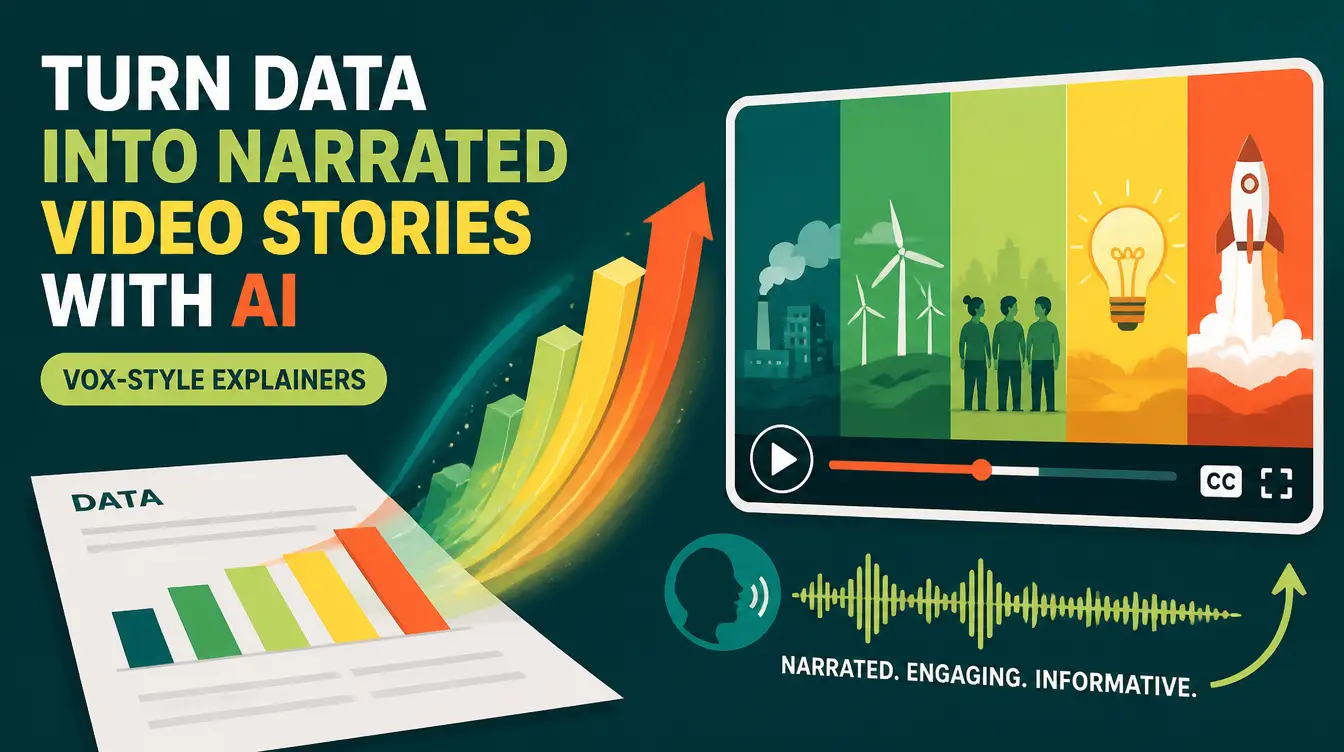
Your quarterly report contains one genuinely surprising number, and that number is currently dying inside a chart that nobody outside the analytics meeting will ever open. This is the quiet tragedy of data: the insight is real, the chart is correct, and the audience simply does not live in spreadsheets. The Vox-Style Motion Graphics skill was built for exactly this gap — it turns a topic, a story, or a data point into a finished, narrated, Vox-style explainer video: the format people actually finish watching.
What is the Vox-Style Motion Graphics skill?
It is a complete, hands-off video pipeline packaged as a free skill. One request — a topic, or nothing at all — becomes a finished narrated explainer video, end to end: research, script, animated collage clips, documentary voiceover, and a single assembled MP4. The ZIP bundle includes the full pipeline definition, the Mixed Media collage style tokens with a block-prompt template and worked examples, and a cinematic paper-diorama documentary playbook with reusable props. We covered the full production walkthrough in the Vox-style explainer guide; this article focuses on its most underrated job — making data move.
Why does data need video instead of slides?
Because a chart answers a question, but a video asks one first. A bar chart of rising costs presents a fact; a narrated video shows the costs climbing while a voice explains who paid them — same numbers, but wrapped in causality and consequence. That wrapper is why explainer videos dominate attention while dashboards collect virtual dust. The skill's Mixed Media collage style was purpose-built for data stories: flat, bright, editorial animation that makes a number the main character of a scene instead of a resident of a grid.
Which of the two house styles fits your story?
| Aspect | Mixed Media collage | Paper-diorama documentary |
|---|---|---|
| Look | Flat, bright, editorial | Sepia newsprint worlds, censor-bar figures |
| Energy | Fast, magazine-like cuts | Cinematic, fake-oner FPV feel |
| Best for | Data stories, explainers, shorts | Geopolitics, money, power |
| Example brief | «Why rent went up 40% in three years» | «Who controls the shipping lanes» |
A dashboard shows the audience what happened. A video makes them feel why it happened — and feeling is what gets shared.
How do you turn a dataset into a finished video, step by step?
- Hand the skill your request — a topic, a headline, or the data story you want told; it can also start from nothing and propose one.
- The pipeline researches the subject and writes the script, structured for narration.
- Animated collage clips are generated in your chosen house style, block by block.
- The documentary voiceover is produced and timed to the visuals.
- Everything is assembled into one MP4 — research to render, without you touching an editor.
Where does the skill run?
Inside AI assistants and agents that can run skill files and call generation tools — Manus, Claude, and ChatGPT are the named targets, and the skill is explicitly Manus-compatible. In practice that means you can brief it inside your agent, go do something else, and come back to a finished file. For teams already running agents through the Manus + skills workflow, the video skill drops straight into the same setup.
What happens after the MP4 exists?
A finished video that nobody finds is a dashboard with extra steps — so package it. The YouTube SEO skill produces a complete, copy-paste-ready package for any video: keyword research, three optimized titles, a full description template with SEO chapters, up to 15 hashtags, and thumbnail concepts. The full breakdown is in the YouTube SEO creator package guide. Together the two skills close the loop from raw data to published, findable story — a pairing that anchors the content-creator stack and appears throughout the best AI skills for marketers in 2026.

What does it cost?
Both the Vox-Style Motion Graphics skill and the YouTube SEO skill are free downloads from the Mahara AI library. Paid skills start at 499 EGP, and the 499 EGP/month subscription lets you claim and keep skills — but the data-to-video pipeline above assembles for free.
The number in your report deserves a better funeral than a shared drive. Open the Mahara AI skills library, download the Vox-style video skill, and let your data tell its story in the format people actually watch.