Your YouTube title is the only line most viewers will ever read — and most creators spend less time on it than on the thumbnail font. The result is titles that describe the video instead of selling the click: accurate, forgettable, invisible in a feed. There is a repeatable way out, and it is not guesswork. Keyword research, three competing hooks, a length limit, and a test between them — that is the method professional YouTube strategists run, and a free skill now packages the entire thing for any video you make. This guide breaks down how to write YouTube titles that get clicked, without clickbait, using the YouTube SEO skill on Mahara AI.
For the full package — descriptions, chapters, tags, thumbnails — see the YouTube SEO skill guide; this piece zooms in on the title alone.
What makes a YouTube title get clicked?
Three things working together: the keyword, the hook, and the length. The keyword puts the video in front of the right searches — YouTube is one of the largest search engines on the planet, and a title nobody searches for is a title nobody sees. The hook makes the promise worth one click of a stranger's attention. The length makes sure neither of the first two gets cut off before the payoff. A title that nails two of the three underperforms a title that nails all three, every single time it appears in a feed.
Why do the first 70 characters decide so much?
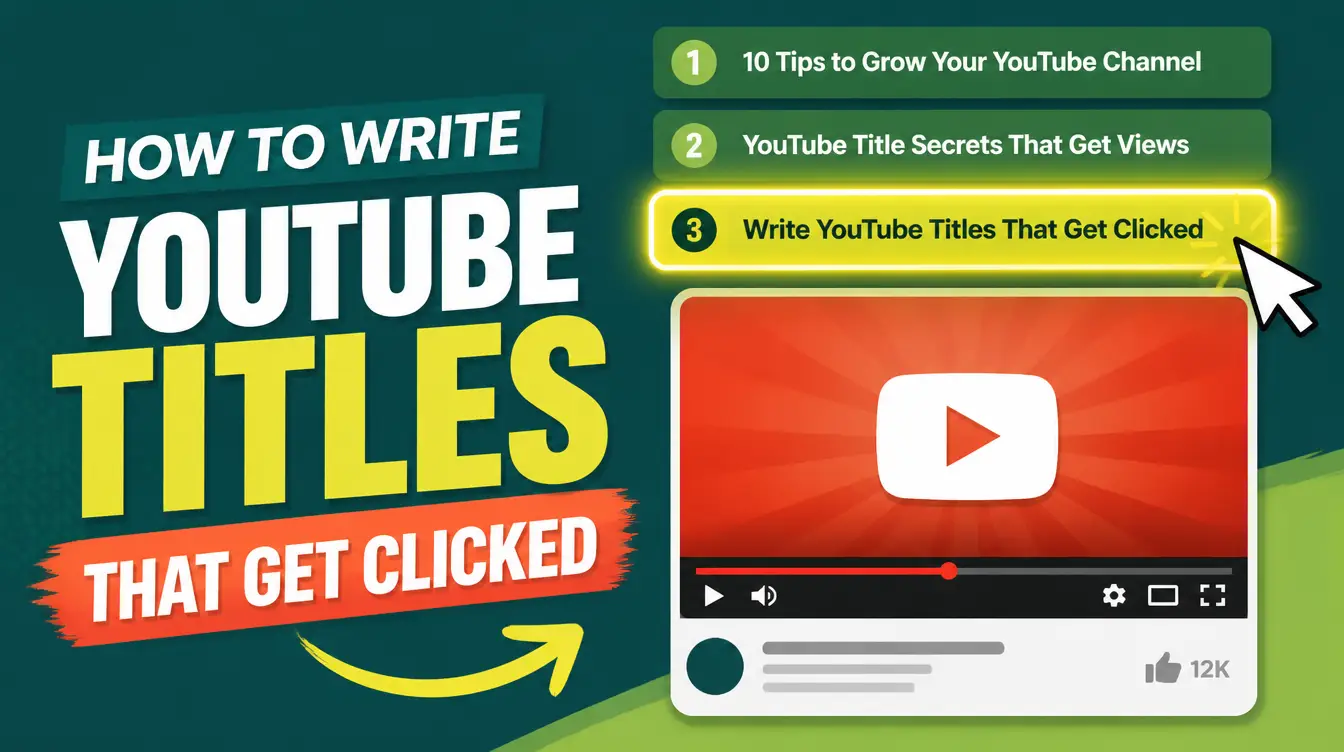
Because that is roughly where YouTube truncates titles in search results and on many surfaces — anything important you place after the cut is written for nobody. The YouTube SEO skill builds this constraint in: it delivers three optimized titles per video, each keyword front-loaded and kept to 70 characters or fewer. Front-loading matters for the same reason: the keyword should survive the cut on a phone screen, where most impressions happen, not sit in the tail of the sentence where it gets amputated.
How do you test three titles against each other?
Three titles, three different psychological hooks, same video. The skill generates exactly this set so you compare promises, not drafts. The classic hook archetypes worth knowing:
| Hook type | It works because… | Example shape |
|---|---|---|
| The specific promise | A concrete, checkable outcome beats a vague topic | «How I did X in Y time» |
| The open loop | A curiosity gap the viewer can only close by watching | «The X nobody tells you about» |
| The identity call | Names the exact person the video is for | «X for beginners who…» |
Write the title before you edit the video. If you cannot make the promise interesting in under 70 characters, the video is not ready — the title is the cheapest place to discover that.
How do you write a title with the YouTube SEO skill, step by step?
- Download the YouTube SEO skill from Mahara AI and load it into your assistant — it works in Arabic, English, or mixed, and reuses what it already knows about your channel, asking only for what is missing.
- Give it the video topic and let it run keyword research across the four quadrants — branded and non-branded, long-tail and short-tail — before a single title is written.
- Choose a competitive analysis mode — Light, Standard, or Deep — so the titles are positioned against what already ranks, not against a vacuum.
- Take the three generated titles, each keyword front-loaded and within 70 characters, and judge them as promises: which one would you click if it were not yours?
- Publish with the winner, and let the skill build the rest of the package around that same keyword — description, chapters, tags, and thumbnail concepts that match the title you chose.
What comes with the title in the full package?
The title is the spearhead of a complete, copy-paste-ready package. The skill writes a full description template with the hook and call-to-action first, an SEO-optimized chapter timeline, related videos, links, and an FAQ section, plus up to 15 hashtags. It delivers three matching thumbnail concepts — generated directly when an image tool is available, otherwise as detailed prompts you can hand to any image generator. And it closes with a best-practices note tailored to your specific video, plus a menu of next steps: an article version, social posts, more thumbnails, or a channel strategy session. Creators running this stack end to end are the audience we wrote AI skills for content creators for.
How do you keep AI-written titles from sounding like AI?
By using the right second skill as editor. The Anti-AI-Slop Content Creator skill exists for exactly this: it hunts the nine machine-writing tells, bans the vocabulary only AI uses, and tunes content per platform — for YouTube specifically, it enforces hook-first scripting so the promise lands before the viewer's patience does. Run your titles through it, and «Unlock the Ultimate Guide to…» dies before it ever reaches your upload page. The same discipline applies across everything you publish, and it is why we treat the two skills as a pair rather than alternatives.
FAQs
How long should a YouTube title be?
Keep it within 70 characters, with the main keyword front-loaded. That is roughly where titles get truncated in search results, so a title that runs long is a title whose payoff is written for nobody.
Can AI write YouTube titles that do not sound robotic?
Yes, when the workflow forces it. The YouTube SEO skill generates three titles with different psychological hooks rather than one safe draft, and the Anti-AI-Slop skill edits machine phrasing out — together they produce titles a human would actually write.
Does the skill work for Arabic YouTube channels?
Yes — the YouTube SEO skill is bilingual, with Arabic and English dual-language guidance, and it was built with an Arabic tech channel as its reference example, so Arabic keyword research is a first-class feature, not a translation afterthought.
Does the skill also make the thumbnail?
It delivers three thumbnail concepts matched to the three titles — generated directly if an image tool is available, otherwise as detailed prompts you can run through any image generator.
Are the skills free?
Both the YouTube SEO skill and the Anti-AI-Slop Content Creator skill are free on Mahara AI. Paid skills start at 499 EGP (about $10 USD), with a 499 EGP per month claim-and-keep subscription and a 7-day refund on every purchase. And when your titles are set, turning your data into video is the natural next skill.
The video is made; the click is won or lost in 70 characters. Get the YouTube SEO skill and give your next upload three titles worth beating.