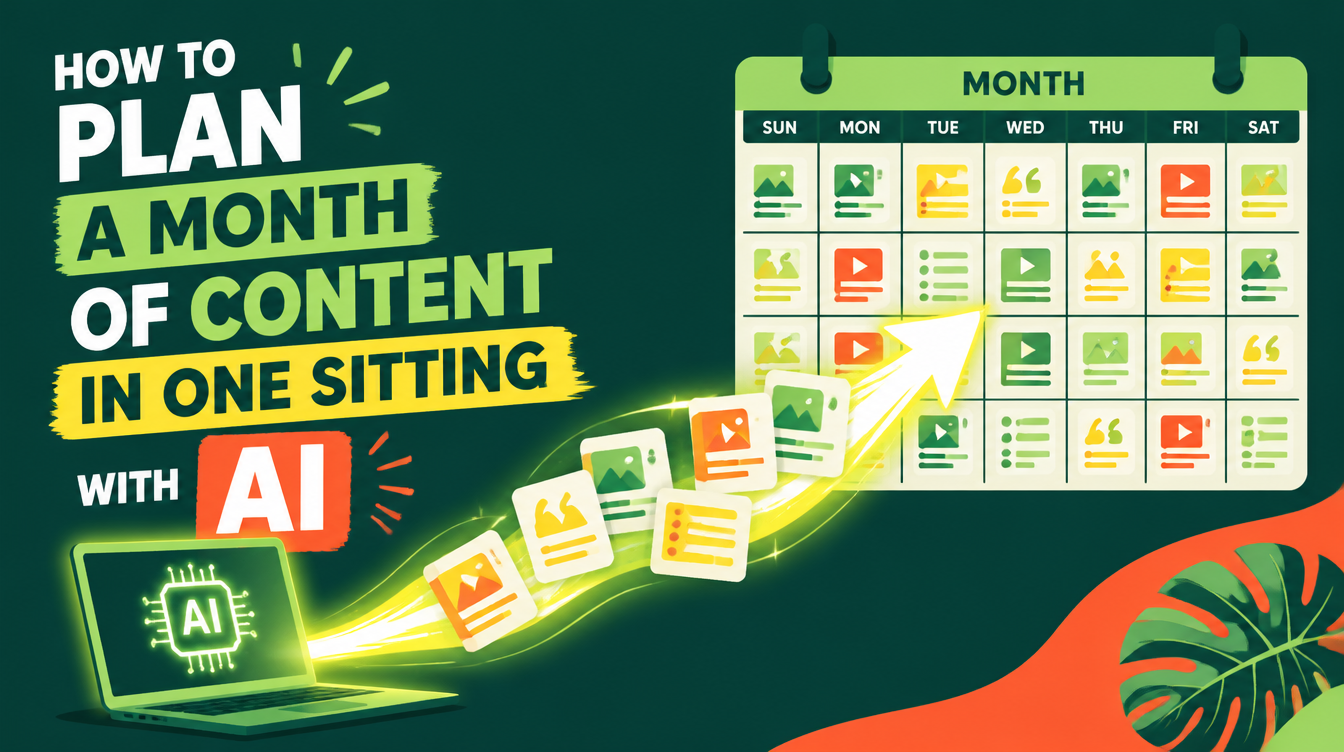
Every content calendar dies the same death. It starts as a beautiful grid — columns for Monday through Friday, color-coded by platform — and it survives about nine days, because a calendar is a schedule with holes where the ideas should be. Come Sunday night you are staring at Tuesday's empty cell, inventing under deadline, and by week three the grid is a monument to guilt. The fix is not a better calendar app; it is a different order of operations: ideas first, calendar second, production third — all of it done in one deliberate sitting with AI doing the heavy layers. Here is that sitting, hour by hour.
The foundation for everything below is what is an AI skill — and the writing philosophy that makes the output worth scheduling is laid out in how to write content with AI without slop and get recommended.
Why do most content calendars fail?
Because they schedule effort instead of ideas. A calendar filled with "post something about pricing" is a to-do list wearing a costume; the real work — the angle, the claim, the hook — still has to be invented on the day. Planning a month in one sitting works only if the sitting produces the actual ideas: for every slot, a specific piece with a specific point of view that a specific reader wants. Get that right and the month becomes execution, which is boring in the best possible way.
What does the one-sitting month look like?
Four layers, in order, and each one is a skill's job:
| Layer | The question it answers | The skill that carries it |
|---|---|---|
| Ideas | What are the 12–20 pieces, and what does each claim? | Anti-AI-Slop Content Creator |
| Packaging | What title, hook, and description does each piece get? | YouTube SEO skill |
| Video versions | Which ideas become short vertical videos? | Make a Reel |
| Calendar | What ships on which day? | You — fifteen minutes and a spreadsheet |
How do you generate the ideas with AI?
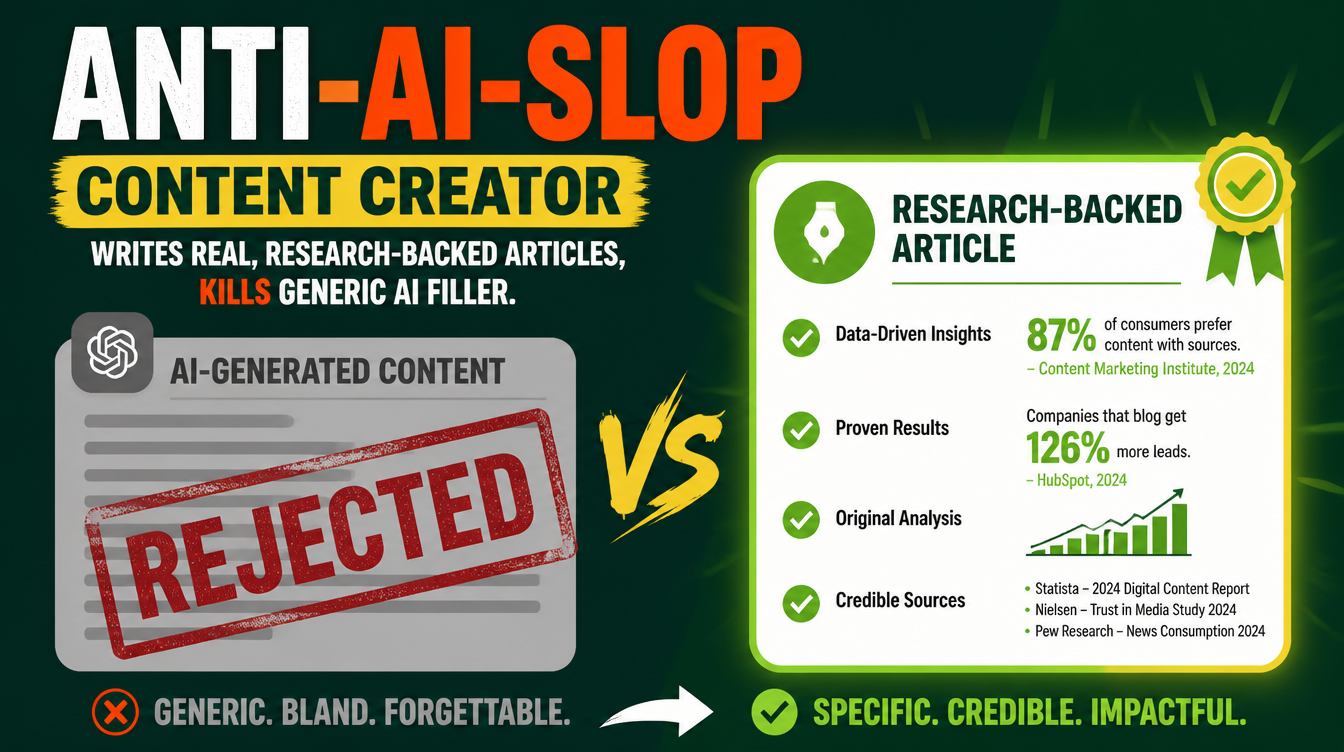
You start with the Anti-AI-Slop Content Creator skill, and you let it do the part it is built for. It interviews you for the claim only you can make — your opinion, your data, your first-hand experience — then researches your niche live, and plans a topical cluster: a set of pieces that cover one theme from enough angles that both readers and search engines see you as the place that theme lives. That cluster is your month. Resist the urge to scatter across five unrelated themes; a month of content about one thing you know deeply beats a month of content about everything, every time.
How do you package each piece so it gets found?
Packaging is a different skill from writing, and the YouTube SEO skill treats it as its own discipline: for each piece it produces keyword-front-loaded title options, a description template with chapters, up to 15 hashtags, thumbnail concepts, and competitive analysis — bilingual, Arabic and English, so the same idea can serve both audiences without being translated into mush. Do the packaging in the same sitting as the ideas, while the intent of each piece is fresh; packaging done later is packaging done worse. The same logic applies to short-form scripts, covered in how to write TikTok scripts with AI that people finish.

What about the ideas that work better as video?
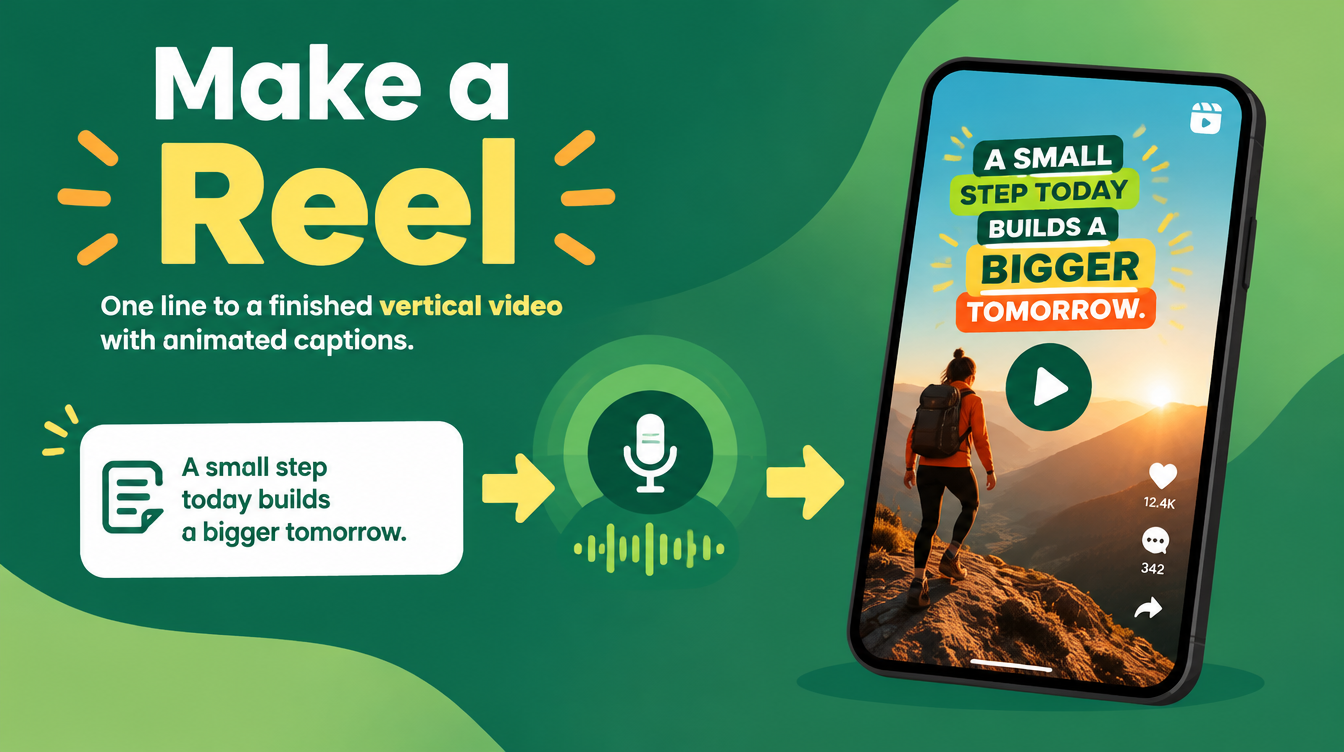
Some of the month's ideas are vertical-video natives: the one stat, the quick tip, the contrarian take that fits in 45 seconds. For those, Make a Reel turns one line into a finished vertical video — script in Egyptian Arabic with tone tags, a free voice, animated scenes, word-by-word captions, final MP4 — so slotting video into the calendar does not become its own production crisis. If you run a whole video operation around the calendar, the wider setup is in the social media manager's stack.
A calendar is not a plan. A list of specific ideas, packaged, scheduled, and produced in batches — that is a plan. The calendar is just where it sleeps.
How do you assemble the actual calendar?
With fifteen minutes and humility. Take the packaged pieces, spread them across the month by effort — heavy pieces on your good days, reels in the dead zones — and leave one slot a week deliberately empty for the thing that will inevitably happen in your niche mid-month. The empty slot is not a gap in the plan; it is the plan acknowledging reality.
What happens at the end of the month?
Two things: measure and refresh. Check which pieces earned attention and which earned silence — the answer usually reshapes next month's cluster. And before you write everything new, remember that updating what already worked is often the higher-return move; the playbook for that is content refresh with AI: update old posts and rank again.
How much does this planning stack cost?
Every skill named in this article is free on Mahara AI. Paid skills on the platform start at 499 EGP (about $10), there is a 499 EGP per month claim-and-keep subscription, and every purchase carries a 7-day refund.
FAQs
Can AI plan a month of content?
Yes, when the month means specific ideas rather than empty slots. The Anti-AI-Slop Content Creator plans a topical cluster of pieces around your own claim and live niche research; the YouTube SEO skill packages each one; Make a Reel produces the vertical-video versions.
What is a content calendar supposed to contain?
Not dates with holes — a schedule of finished ideas: for every slot, a specific piece with a specific claim, plus its title, hook, and format, decided before the month starts. Execution then becomes boring, which is the goal.
Should I plan around one topic or many?
One. A month of content about one theme you know deeply builds topical authority with both readers and search engines; a month scattered across five themes builds nothing but fatigue.
How long does the one-sitting plan take?
The planning sitting itself is an afternoon: the idea interview and cluster, the packaging pass, the reel scripting, and fifteen minutes of calendar assembly. Production afterwards happens in weekly batches.
Is the planning stack free?
Yes, every skill named here is free on Mahara AI. Paid skills start at 499 EGP (about $10), with a 499 EGP per month claim-and-keep subscription and a 7-day refund on every purchase.
Sunday night is coming, and Tuesday's cell is empty again. Open the Mahara AI skills library, book the sitting, and give the next month its ideas before it asks for them.