
Your best blog post is not the one you wrote last week — it is the one you wrote two years ago, because it has rankings, backlinks, and history that a new post starts with none of. A content refresh with AI rescues those assets: instead of writing from zero, you audit what the page already has, fix what aged, restructure what search engines and AI answer engines now expect, and republish with the original authority intact. Two free Mahara AI skills run the whole refresh: one audits the page and returns a prioritized action plan, the other rewrites the weak sections without the filler that got your niche filtered in the first place. This guide is the full workflow.
The concept, for newcomers: a skill is an instruction bundle that gives an AI agent like Manus or Claude a complete methodology. Two minutes on what is an AI skill — then back to your archive, where the money is.
Why does old content decay instead of compounding?
Because the page that ranked in 2024 is answering a 2024 question with 2024 structure. Search intent shifts, competitors publish fresher answers, screenshots and prices age, and the AI answer engines that now sit above the results page cite pages structured for extraction — question-shaped headings, self-contained answers, FAQ blocks. Decay is not a penalty; it is the world moving. The fix is not deletion and a fresh start — that throws away accumulated authority — it is targeted repair:
| What ages on a page | What the refresh does |
|---|---|
| Facts, prices, screenshots, statistics | Verifies and updates each one — or removes the ones that cannot be verified |
| Titles and headings written for an older intent | Re-aligns keywords with what searchers type now, per the audit's intent analysis |
| Wall-of-text sections | Splits into question-shaped H2s with answer-first openings — the structure AI engines lift |
| Missing FAQ and schema | Adds the FAQ block and structural improvements the audit flags |
How does the audit know what to fix first?
The SEO & AEO Analysis skill reads the page and returns a prioritized action plan, not a generic checklist. It audits on-page performance and flags the quick wins; analyzes keyword opportunities and their alignment with search intent — catching the pages still ranking for what nobody searches anymore; evaluates the page's readiness for AI answer engines like ChatGPT, Perplexity, and Google's AI Overviews; and suggests structural improvements — headings, schema, FAQs — aimed at the positions where snippets and citations are won. Prioritization matters because refreshes fail by trying to fix everything at once: the audit's ranked list tells you the three changes that carry the page, and the rest can wait for the next cycle. The skill is documented in the free website optimization guide and compared with classic SEO in SEO vs AEO.

Who rewrites the sections — and how do you avoid injecting slop?
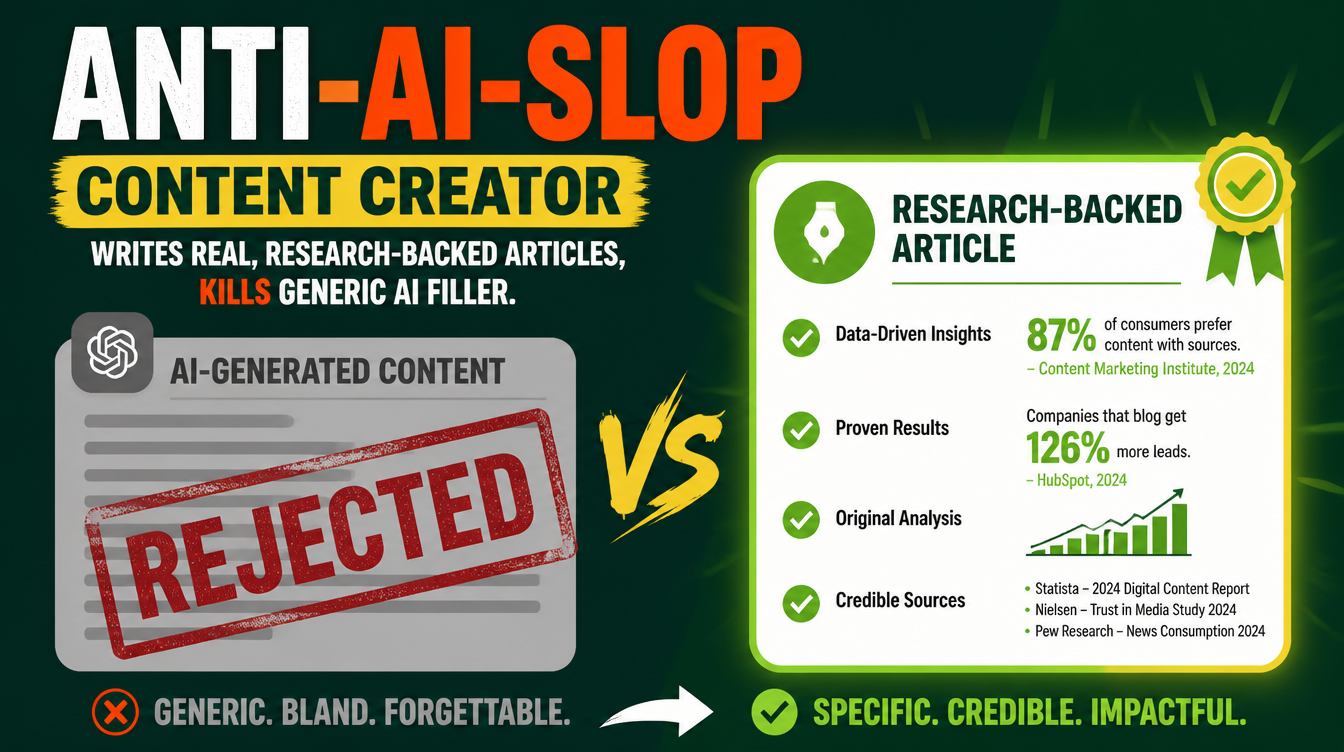
The rewriting is where most refreshes quietly make things worse: the old page gets padded with the exact machine-generated filler that search engines and readers have learned to discount. The Anti-AI-Slop Content Creator skill is built against that failure. It hunts the nine slop tells — hollow claims, throat-clearing, manufactured enthusiasm, the rule-of-three cadence that marks machine text — bans the filler vocabulary outright, and enforces the replacement test: every rewritten sentence must say something the generic version of the article could not. And it never invents a statistic or citation to freshen a page — the new number goes in only if it is real and you can source it. The full methodology is in the anti-slop writing guide.
A refreshed page is compound interest on work you already did. A deleted page is closing the account.
What is the refresh workflow, step by step?
- Pick the pages with traffic history and positions worth defending — pages ranking between positions 5 and 20 are the classic highest-return refresh targets.
- Run the SEO & AEO Analysis skill on each page and read the prioritized action plan before touching anything.
- Fix the rot first: outdated prices, broken links, aged screenshots, and any claim that can no longer be verified.
- Restructure per the audit: question-shaped headings, answer-first openings, the FAQ block, and the schema improvements it flags.
- Rewrite the weak sections with the anti-slop skill's constraints — real facts only, zero filler vocabulary, every sentence passing the replacement test.
- Republish with the updated date visible, and re-run the audit after a few weeks to confirm the changes moved the page.
When should you rewrite versus write something new?
Refresh when the page has history worth keeping — rankings, links, or accumulated authority on a question people still ask. Write new when the question itself changed into a different question, or when the old page never earned anything worth defending. Most blogs discover, once they audit, that their fastest wins are sitting in posts they forgot they had — and the same audit-first thinking applies across the whole marketing stack. If you are deciding where to begin, start with which AI skill to download first.
FAQs
What is a content refresh in SEO?
Updating an existing page — its facts, structure, headings, and schema — so it competes with today's search results and AI answers, instead of writing a new page from zero. The old page keeps its accumulated rankings and history, which a new URL starts without.
How often should I refresh old blog posts?
Audit on a cycle — quarterly for pages that earn traffic, and whenever a page visibly drops. The SEO & AEO Analysis skill's prioritized plan tells you which pages deserve the work now; pages ranking between positions 5 and 20 are the classic highest-return targets.
Can AI refresh content without making it sound machine-written?
Yes — the Anti-AI-Slop skill exists for exactly that. It hunts the nine machine-writing tells, bans the filler vocabulary, applies the replacement test to every sentence, and never invents a statistic to make a page look fresher.
Does updating a page hurt its rankings?
Not when the update is real: verified facts, better structure, and honest rewriting with the original URL and its history preserved. What hurts is padding a page with filler to look fresh — which is the specific failure the anti-slop skill is built to prevent.
Are both skills free?
Yes — the SEO & AEO Analysis skill and the Anti-AI-Slop Content Creator are free on Mahara AI. Paid skills on the platform start at 499 EGP (about $10 USD), there is a 499 EGP per month claim-and-keep subscription, and every purchase carries a 7-day refund.
Your archive is an asset, not a graveyard. Download the two skills, audit the ten oldest posts tonight, and let the pages that already rank start earning again.