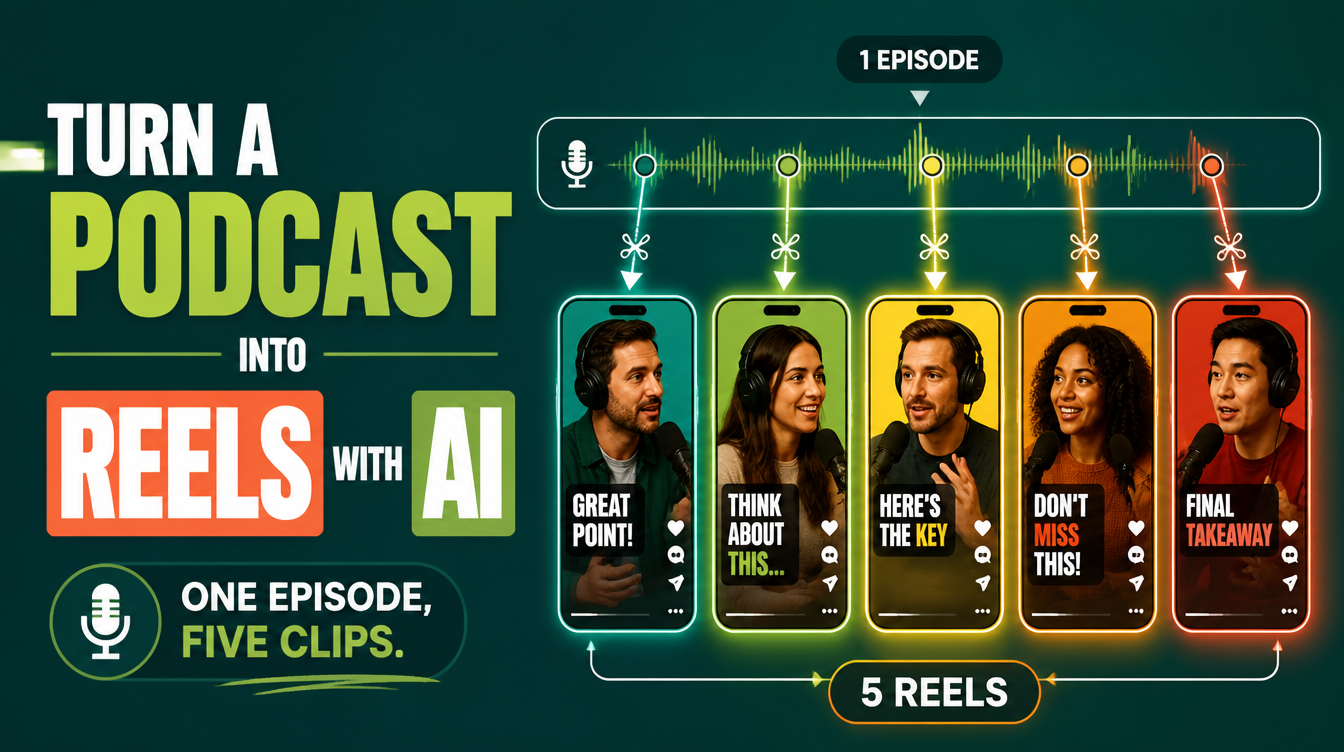
You record a great hour. It performs great — for the people who already follow you. Meanwhile the audience that discovers creators through short vertical video never hears it, because turning one long episode into five good clips means scrubbing timelines, fighting editors, and re-recording captions nobody can read on a phone. Here is how to turn a podcast into reels with AI — one episode, five finished vertical clips, without learning an editing suite — using two free skills that treat clips as productions, not crops.
If the concept of AI skills is new, the two-minute primer is what is an AI skill — and if you podcast seriously, pair this with the best AI skills for podcasters for the full workflow around each episode.
Why doesn't clipping the episode manually work?
Because a clip is not a crop. The raw 90 seconds where you said something brilliant does not work as a reel: it has dead air, an in-joke from minute 40, and audio mixed for earbuds in a quiet room — not for a phone speaker in a noisy one. A reel that performs is a re-production: a tightened script, a clear voice take, captions synced word by word, and scenes built to hold attention at 1080x1920. That is why most podcasters quit clipping after week two — not from lack of clips, but because every clip is secretly a small production job.
What does the AI workflow look like end to end?
It has three stages, and each one is a skill's job. First, pick the moments: give your assistant the episode and ask for the five strongest self-contained ideas — the take, the story, the number, the disagreement, the how-to. Second, write the clip scripts: each moment becomes a short script with a hook in the first two seconds and tone tags that tell the voice how to perform, not just what to say. Third, produce: the script goes in, a finished MP4 comes out — voice, captions, scenes, all assembled. The two Mahara AI skills below cover stages two and three completely.
How does Reel Maker produce the finished clip?
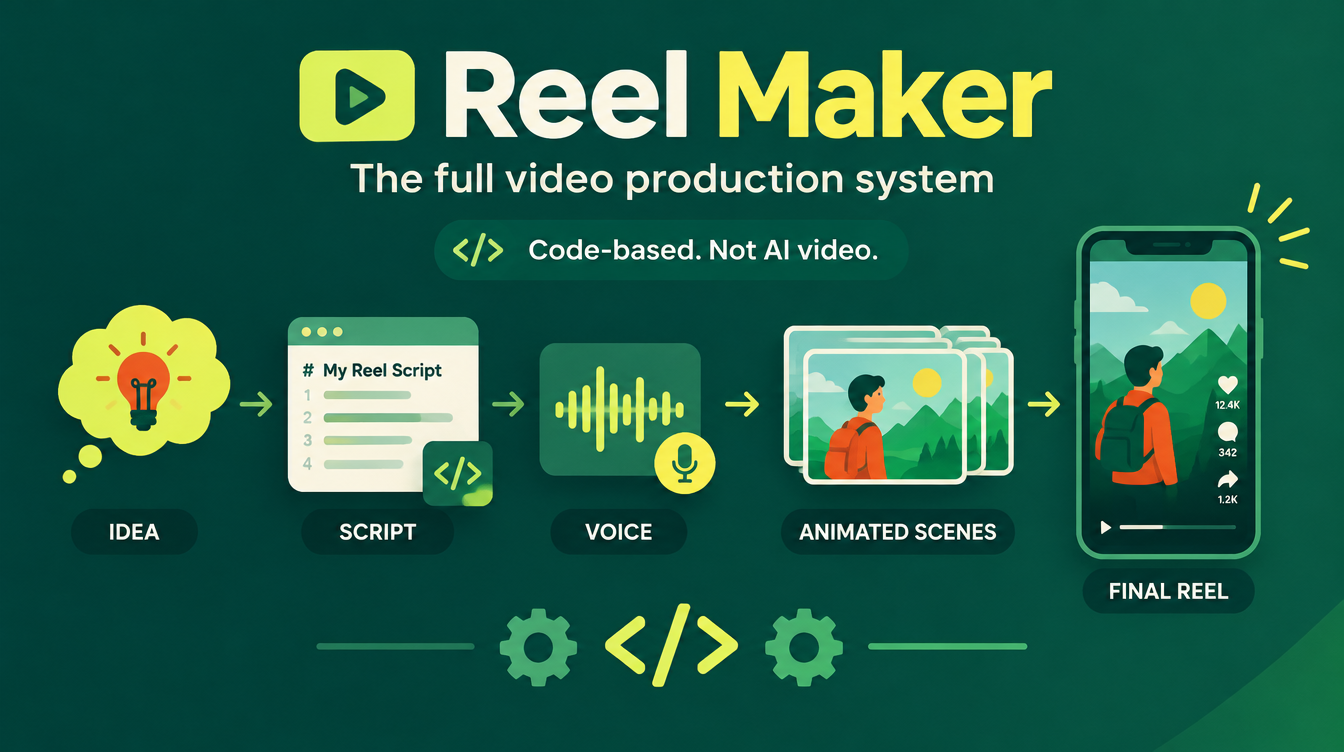
Reel Maker is a code-based reel production system, and that word — code-based — is the whole point. Instead of asking an AI video model to imagine your clip (and re-rolling every render when Arabic letter joining breaks or text warps), it renders HTML with GSAP, so every frame is exact and editable. The pipeline runs from script to final 1080x1920 MP4: a script formula with tone, voice in four tiers — the free Edge Egyptian voices Shakir and Salma, your own phone recording, ElevenLabs v3, or OpenAI TTS — Whisper word-level timings for the captions, kinetic captions, animated scenes with a talking presenter, a text-overlap scanner, licence-free sound effects, and audio normalized to -14 LUFS. The download ships with 17 scripts, 5 reference files, and 2 templates with fonts bundled. The full system tour is in Reel Maker: the full AI video production system.
How does this compare to the alternatives?
Three ways exist to get from episode to clips, and they are not equal:
| Approach | What you get | Where it breaks |
|---|---|---|
| Manual clipping in an editor | Full control, full labor | Five clips a week is a part-time job most shows abandon |
| Auto-crop tools | Fast slices of the episode | Crops, not productions — dead air, no hooks, phone-unreadable captions |
| AI video generators | Imagined footage per prompt | Re-rolls on every render; Arabic text warps; nothing is fixable, only retried |
| Skill pipeline (script → exact render) | Finished MP4 with captions and scenes | Needs the skill loaded — setup is minutes, once |
An episode is a conversation. A reel is a performance of the best 45 seconds of that conversation — written, voiced, and staged. Treat it like one and it compounds; treat it like a crop and it disappears.
What about the clip that needs to be short and fast?
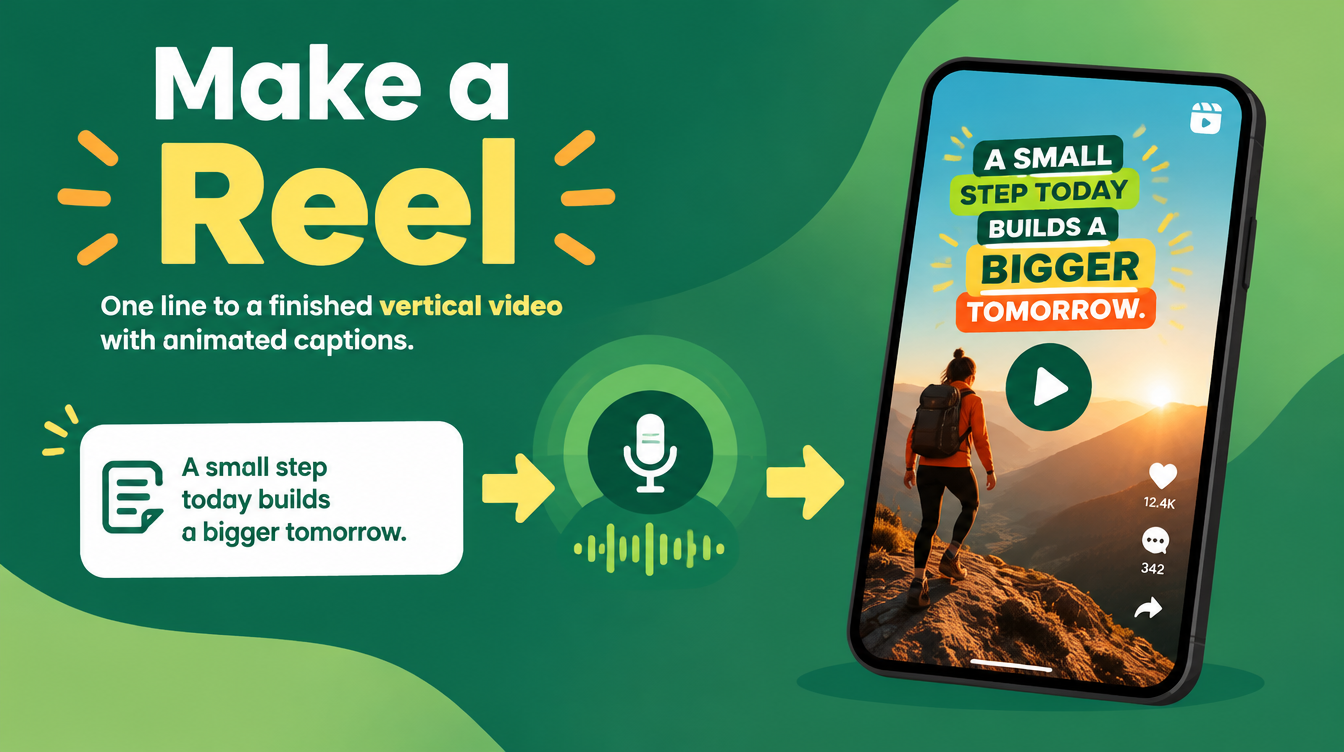
Not every clip deserves the full production. For the quick one — a tip, a punchline, a single stat — Make a Reel turns one line into a finished 45–60 second vertical reel: an Egyptian Arabic script with tone tags, a free Edge TTS voice, animated paper-style scenes, word-by-word captions, and a final MP4. The scenes are an HTML template, so you can re-time a frame or re-word a card before posting. The walkthrough lives in Make a Reel: from one line to a finished vertical video.
How do you package the clips so people find them?
Production gets you the video; packaging gets you the viewer. The YouTube SEO skill applies the same discipline to shorts and clips that it applies to long videos: keyword-front-loaded titles, descriptions with chapters, hashtags, thumbnail concepts, and competitive analysis — bilingual, Arabic and English, so the same clip can serve both audiences. It is the same logic behind the complete creator package.

How much does this podcast-to-reels stack cost?
Every skill named here is free on Mahara AI. Paid skills on the platform start at 499 EGP (about $10), there is a 499 EGP per month claim-and-keep subscription, and every purchase carries a 7-day refund.
FAQs
Can AI turn a podcast into reels?
Yes. Pick the five strongest self-contained moments from the episode, write each as a short clip script, then run it through the Reel Maker pipeline — script, voice, word-level captions, animated scenes — to a finished 1080x1920 MP4.
Why not just crop the best 60 seconds of the episode?
Because a crop is not a clip. Reels that perform are re-productions: tightened scripts with an early hook, clean voice takes, captions synced word by word, and scenes staged for a phone screen.
What voices can the clips use?
Reel Maker supports four tiers: the free Edge Egyptian voices Shakir and Salma, your own phone recording, ElevenLabs v3 for the best Arabic and tone obedience, or OpenAI TTS. Timings come from Whisper word-level timestamps.
Does it work for Arabic content?
Yes — it is built for it. Rendering is code-based HTML and GSAP rather than AI video generation, so Arabic letter joining and text stay exact, and the default script layer in Make a Reel is Egyptian Arabic by design.
Is the podcast-to-reels stack free?
Yes, every skill named here is free on Mahara AI. Paid skills start at 499 EGP (about $10), with a 499 EGP per month claim-and-keep subscription and a 7-day refund on every purchase.
Your last episode has five reels hiding in it. Open the Mahara AI skills library, load Reel Maker and Make a Reel, and let next week's episode work the vertical feeds as hard as it works the podcast apps.