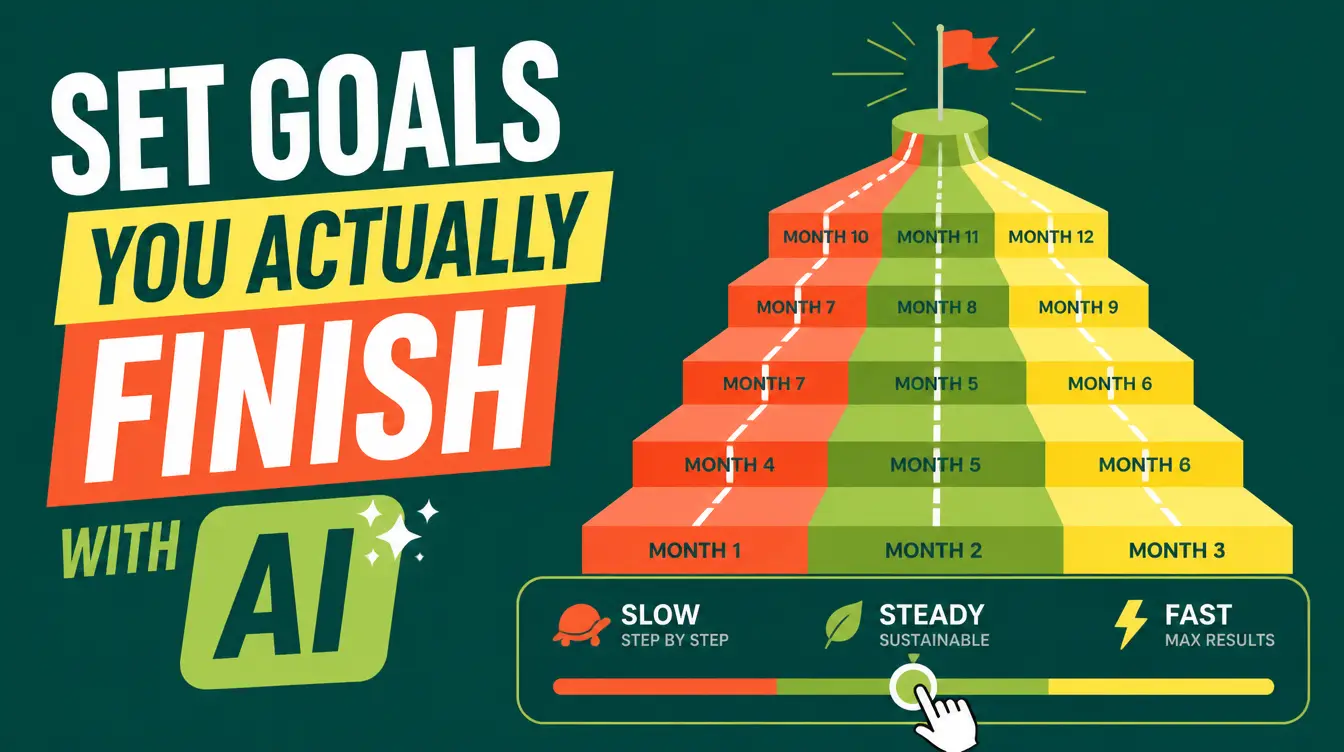
To set goals you actually finish, two things must be true that usually are not: the goal must survive a feasibility check, and it must arrive with a month-by-month plan attached. That is precisely what two Mahara AI skills deliver. Goal Architect takes your financial pain or dream, pulls your real numbers, tests whether the goal is achievable, and builds a monthly action plan in three intensities. Financial Goal Planner turns any goal into a live calculator where you can edit scenarios in real time. This guide shows how to run both, in one sitting, so the goal you set this month is one you finish this year.
New to skills generally? Start with why you need AI skills in 2026 — then come back and set the goal.
Why do most goals die by February?
Because they were wishes with a deadline. A wish says "I want to save for an apartment"; a goal says how much, from what income, against what expenses, at what monthly rate, with what feasibility. When the plan behind the number does not exist, the first hard month kills the goal — not from weak character, but from missing arithmetic. The two skills below exist to do that arithmetic before you commit, and to keep it visible after you do.
| Goal ingredient | Wish version | Skill-assisted version |
|---|---|---|
| The number | "As much as I can save" | A precise target defined from your real income and expenses |
| Feasibility | Never checked | Tested up front, before the plan is built |
| The plan | A vague intention | Month-by-month, in conservative, balanced, or aggressive intensity |
| Course correction | Give up at the first bad month | Live scenario editing — change a number, see the new plan instantly |
How does Goal Architect test a goal before you commit?
It starts by listening. Tell the Goal Architect skill your financial pain or your dream — the apartment deposit, the emergency fund, the debt that breathes down your neck. It pulls real financial context, your income, your expenses, your subscriptions, defines the goal precisely, and then runs the step everyone skips: a feasibility test. If the goal cannot survive your actual numbers, you find out in the first session, not in month six. If it can, the skill builds a customizable savings plan in three flavors — conservative, balanced, or aggressive — and hands you an interactive dashboard with goal tracking.
The full method is in Goal Architect: monthly action plans — the skill that made "month-by-month" the default unit of planning.

What if you need to see the plan move before you trust it?
That is the Financial Goal Planner's job. It takes any financial goal — property, car, wedding, investment, emergency fund — and builds a single-file interactive HTML calculator: affordability, hidden costs, monthly savings plans, and Islamic finance options, with real-time scenario editing. Slide the monthly amount, change the timeline, add the hidden costs everyone forgets, and watch the finish line move. A plan you have stress-tested yourself is a plan you defend on bad months.
See the Financial Goal Planner guide for what goes into the calculator — especially the hidden-cost checklist, the quiet killer of savings plans.

You do not need more motivation. You need arithmetic that survives your worst month, and a plan that shows you the finish line moving when life happens.
How do you set one goal you will actually finish?
- Name the pain or the dream in one sentence — the deposit, the fund, the number that would change your year.
- Open Goal Architect and let it pull your real context: income, expenses, subscriptions.
- Accept the feasibility verdict. If the goal fails the test, resize it — a finished smaller goal beats an abandoned heroic one.
- Choose your intensity: conservative for a hard year, balanced for a normal one, aggressive when income has room.
- Take the monthly plan into the Financial Goal Planner and stress it: edit scenarios live until you have seen your worst month and survived it on the calculator.
- Track monthly. The dashboard and goal tracking are built for the check-in, not just the kickoff.
Should you run this on company and personal goals together?
Yes — with two separate runs. Founders and freelancers whose business and personal money share one pool abandon goals fastest, because every bad month hits both plans at once. Run Goal Architect once for the business number and once for the personal one; the feasibility tests will tell you if you are funding both from the same pocket. If you want to build the habit of using skills weekly, the 7-day skill challenge is a good companion.
FAQs
How do I set goals I actually finish?
Define the goal precisely from your real numbers, test its feasibility before committing, attach a month-by-month plan, and stress-test that plan against your worst month. The Goal Architect and Financial Goal Planner skills automate all four steps.
What does Goal Architect do?
It listens to your financial pain or dream, pulls real context — income, expenses, subscriptions — defines the goal precisely, tests feasibility, and builds a customizable savings plan in conservative, balanced, or aggressive intensity, with an interactive dashboard and goal tracking.
What is the feasibility test?
It is the step that checks the goal against your actual financial context before the plan is built. A goal that fails the test gets resized in the first session instead of dying in month six.
Can I plan with Islamic finance options?
Yes. The Financial Goal Planner covers affordability, hidden costs, and monthly savings plans including Islamic finance options, with scenarios that update in real time.
How much do these skills cost?
Some skills on Mahara AI are free. Paid skills start at 499 EGP (about $10 USD), there is a 499 EGP per month claim-and-keep subscription, and every purchase carries a 7-day refund.
The goal you keep postponing is one feasibility test away from either a plan or a rewrite. Browse the Mahara AI skills library and give it the test tonight.