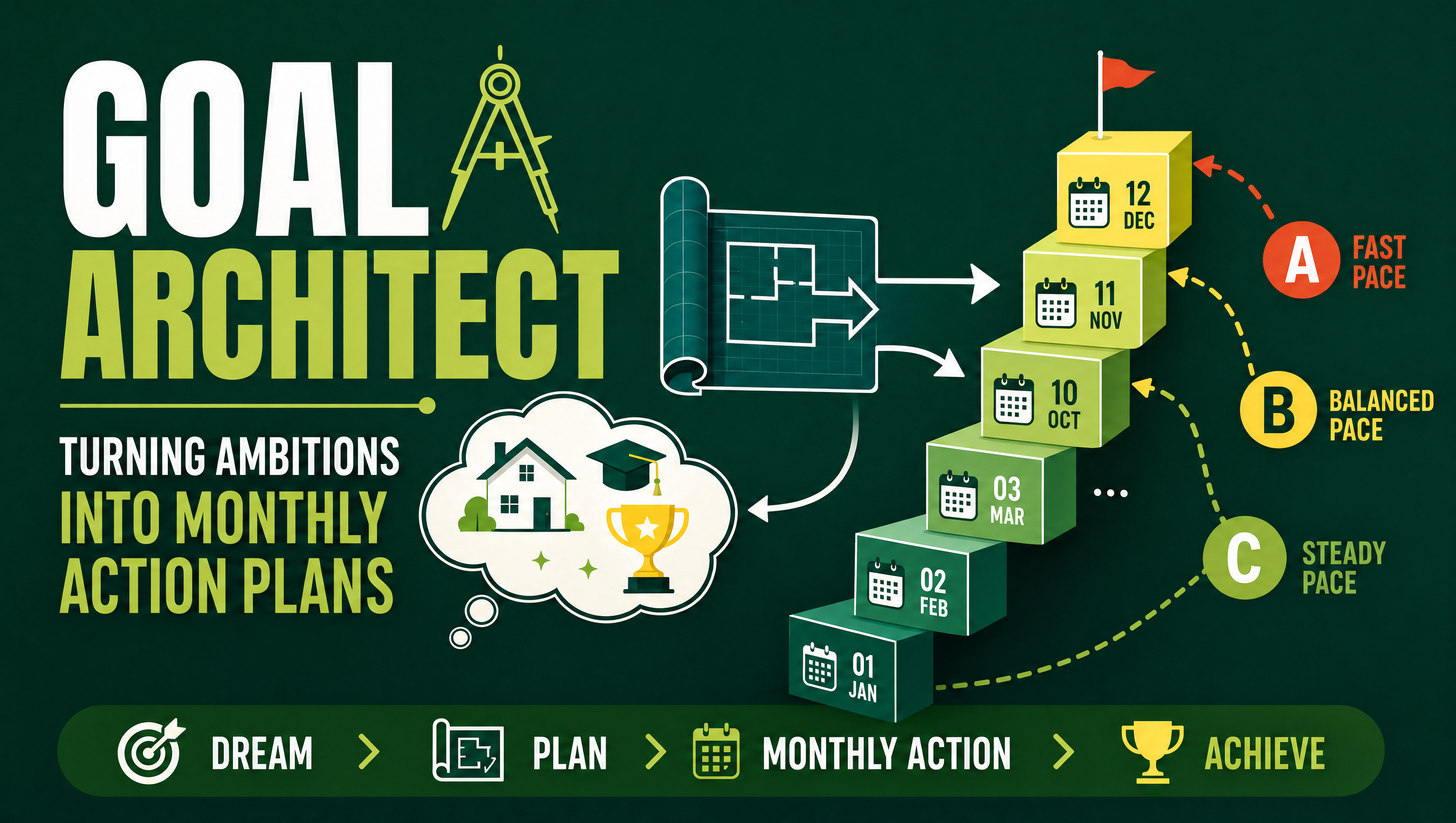
Most goals die for one boring reason: they never become a plan. The Goal Architect skill exists precisely for that gap. It is an AI skill that takes a stated ambition — buy a home, clear debt, build a side income — and converts it into a month-by-month action plan, tested against your real data instead of wishful thinking.
If you are new to the concept, an AI skill is a downloadable bundle of instructions that teaches an assistant like Claude or Manus to do one job well. You can find free options in where to find free AI skills, or browse 5 free AI skills that save you hours for quick wins before diving into this deep dive.

What exactly does the Goal Architect skill do?
Goal Architect turns a vague ambition into a structured monthly plan. You state a goal and a deadline, share your real numbers — income, expenses, subscriptions — and the skill builds a plan with feasibility checkpoints. It does not just generate optimistic to-do lists; it pulls your actual data and tests whether the goal survives contact with your budget.
Who is the Goal Architect skill for?
It suits anyone whose goal has numbers attached: savers working toward a purchase, professionals planning a career move, students structuring a semester — the same audience that benefits from our best AI skills for students in 2026. If your goal can be broken into monthly milestones, this skill can architect it.

How does the 5-step flow work?
You state the goal and the deadline. The skill restates it in measurable terms so there is no ambiguity about what success looks like.
You share real numbers — income, expenses, subscriptions. This is the raw material; the more honest the inputs, the more useful the plan.
The skill runs a feasibility test, checking whether the goal is reachable on your current trajectory or needs adjustment.
It builds three tracks — conservative, balanced, and aggressive — each with a different pace and monthly commitment.
You follow monthly checkpoints with an interactive tracking-dashboard feel, adjusting as real life diverges from the plan.
The plan is only as honest as your numbers. Goal Architect will architect anything you ask — the feasibility test is what keeps it grounded in reality rather than motivation.
Which track should you choose?
| Track | Pace | Best for |
|---|---|---|
| Conservative | Slow and steady, minimal monthly strain | Tight budgets or unstable income |
| Balanced | Steady progress with lifestyle intact | Stable income and moderate urgency |
| Aggressive | Fastest pace, highest monthly commitment | Hard deadlines and room to cut spending |
How is this different from just asking an assistant for a plan?
A plain prompt produces a plan shaped by whatever the model guesses about your life. Goal Architect inverts that: the plan is shaped by the numbers you actually provide. The skill also enforces the discipline most people skip — the feasibility test and the monthly checkpoints — so the output is not a motivational document but a schedule with a reality check attached. And because it is a reusable skill rather than a clever one-off prompt, the second and tenth goals get the same rigor as the first.
What happens at a monthly checkpoint?
Each checkpoint asks a simple question: did the month go as planned, and if not, by how much? You update the numbers, the skill recalculates the trajectory, and you either stay on your track or shift to a different pace. A missed month does not collapse the plan; it just becomes the new baseline. That is what makes the tracking feel like a dashboard rather than a diary — every checkpoint is a decision point, not a guilt trip.
What is the Goal Architect skill NOT?
It is not a magic pill. It will not invent income you do not have or hit a deadline your numbers cannot support — the feasibility test will tell you that honestly. It also needs your real data; a goal planned on guessed numbers is just a nicer-looking guess. What it does is convert ambition into sequence, and sequence into months.
FAQs
What is the Goal Architect skill?
It is an AI skill that turns a stated goal into a month-by-month action plan, using your real income, expenses, and subscriptions to test feasibility.
Do I need to share my real financial numbers?
Yes. The feasibility test and the three tracks are only as accurate as the data you provide — real numbers are what separate a plan from a wish.
What are the conservative, balanced, and aggressive tracks?
They are three versions of the same plan at different paces, letting you pick the monthly commitment that matches your budget and deadline.
Can it adjust the plan mid-way?
Yes. The monthly checkpoints exist exactly for that — when reality diverges, you revisit the track and continue from an updated baseline.
Do I need any setup beyond the skill itself?
No special setup. Once the ZIP is loaded into your assistant, everything happens in conversation — you state the goal, paste or describe your numbers, and the skill handles the structure.
Where do I get the Goal Architect skill?
You can download it from Mahara AI as a ZIP bundle and run it in assistants like Claude or Manus.
Have a goal that deserves a real plan? Browse the skills library on Mahara AI and let the Goal Architect build your next twelve months.