"Should I be learning skills or MCP?" The question arrives in every AI discussion now, usually asked by someone who suspects they are being left behind by two acronyms at once. Here is the calm answer: skills and MCP are not rivals fighting for the same job. One is how you teach an AI what you know; the other is how you wire an AI to the world. They live at different layers of the same stack, they compose rather than compete, and by the end of this comparison you will know exactly which one your problem needs — probably both.
If the term "skill" itself is new to you, the foundation piece is what is an AI skill — and its sibling comparison is AI skills vs. Claude skills. This article completes the trio with the protocol layer.
What is an AI skill, exactly?
An AI skill is a packaged set of instructions — a SKILL.md file with its references and templates — that you load into an assistant to make it reliably good at one job. It carries expertise: the workflow, the standards, the gotchas, the definition of done. A skill does not plug your assistant into anything new; it changes how the assistant thinks and works on a class of tasks. Download a contract-review skill and your assistant stops improvising legal-sounding guesses and starts scoring every clause systematically. The packaging is the point: the expertise is written once by someone who has it, and reused by everyone who downloads it — the model behind how skills hold context better than prompts.
What is MCP, exactly?
MCP — the Model Context Protocol — is an open standard introduced by Anthropic in late 2024 and since adopted across the industry, including by OpenAI and Google. It defines a standard way to connect an AI model to external tools and data sources: files, databases, APIs, web search, anything with a server. Before protocols like MCP, every integration was bespoke wiring; with it, a tool that speaks MCP can be used by any MCP-capable model. MCP does not carry expertise. It carries capability — the connection itself.
So what is the actual difference?
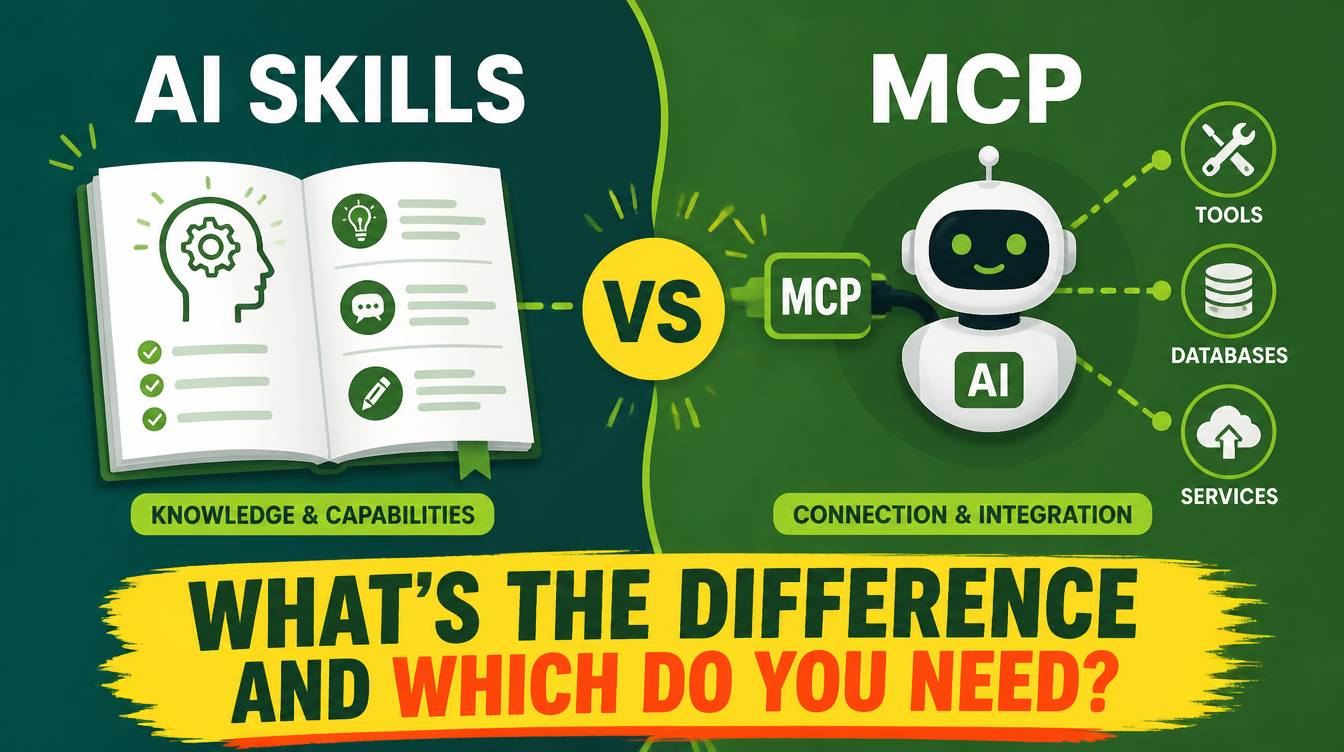
Skills are knowledge; MCP is wiring. A skill answers "how should this be done?" An MCP server answers "what can this be done to?" The cleanest way to see it:
| AI skill | MCP server | |
|---|---|---|
| What it is | A package of instructions and references (SKILL.md) | A standardized connection to a tool or data source |
| What it gives the AI | Expertise, workflow, standards, judgment | Access — to files, APIs, databases, live data |
| Where it lives | Loaded into the assistant's context | Running as a service the assistant calls |
| Who writes it | Anyone with domain expertise | Anyone with a tool or data source to expose |
| Fails when | The instructions are shallow or generic | The connection is down or the data is stale |
| Analogy | The training manual | The power outlet |
A skill with no connection is an expert locked in a library. A connection with no skill is a fast car with no driver. The interesting systems run both.
Do skills and MCP work together?
Constantly — and the clearest proof lives in the Mahara AI library itself. The Quranic Scholar skill is a study method: how to retrieve, cite, and explain. It runs on a Tafsir MCP server that connects it to eight authoritative tafsir sources — Tabari, Ibn Kathir, Baghawi, Sa'di, Muyassar, and more — retrieving verses and exegesis verbatim. The skill decides what to ask for and how to present it; the MCP server is what makes the asking possible. Same pattern in the Real Estate Finder skill: its advisory workflow stands on its own, and when the Exa MCP server is available, it enriches the analysis with live market data. Skill on top, protocol underneath — the layering is not a compromise; it is the architecture.
Which one do you need?
Diagnose the bottleneck. If your assistant is connected to everything and still does mediocre work, you have an expertise problem — get skills. If it works brilliantly in theory but cannot touch your files, your data, or the live web, you have a connection problem — set up MCP servers. And if you are building anything ambitious, expect to need both: the skill that encodes how the work should be done, and the protocol that hands the work its raw material. That composition is precisely how the skills in the library are built to run — with assistants and agents like Manus, Claude, and ChatGPT, as covered in how to use AI skills with Manus.
What does a skill look like when you hold one?
Two from the library, chosen because they show the range. The Best Price Finder skill encodes a research workflow: how to build a live price comparison for a purchase decision — what to compare, how to verify, how to present the verdict. The YouTube SEO skill encodes a production standard: three keyword-front-loaded titles, a description template with chapters, up to 15 hashtags, thumbnail concepts, and competitive analysis per video, in Arabic and English. Neither contains a single wire to the outside world — and both, in the hands of a connected assistant, produce work that looks like it came from a specialist.


How much do skills on Mahara AI cost?
Some skills are free, and paid skills start at 499 EGP (about $10). There is a 499 EGP per month claim-and-keep subscription, and every purchase carries a 7-day refund.
FAQs
What is the difference between AI skills and MCP?
A skill is a package of instructions and references that teaches an assistant how to do a job well; MCP is an open protocol that connects a model to external tools and data sources. Skills carry expertise, MCP carries access — they solve different layers and are used together.
Do skills and MCP compete with each other?
No. Skills run on top of connections that protocols like MCP provide. The Quranic Scholar skill, for example, runs on a Tafsir MCP server that connects it to eight authoritative tafsir sources.
Which should I learn first?
Diagnose your bottleneck. Mediocre output from a well-connected assistant is an expertise problem — get skills. Great output that cannot touch your files or live data is a connection problem — set up MCP servers.
Who created MCP?
Anthropic introduced the Model Context Protocol in late 2024 as an open standard for connecting AI models to external tools and data, and it has since been adopted across the industry, including by OpenAI and Google.
Where do I get AI skills?
The Mahara AI library. Some skills are free, paid skills start at 499 EGP (about $10), there is a 499 EGP per month claim-and-keep subscription, and every purchase carries a 7-day refund.
Stop treating it as either-or. Browse the Mahara AI skills library, pick the job you need done expertly — and let the protocols handle the plumbing.