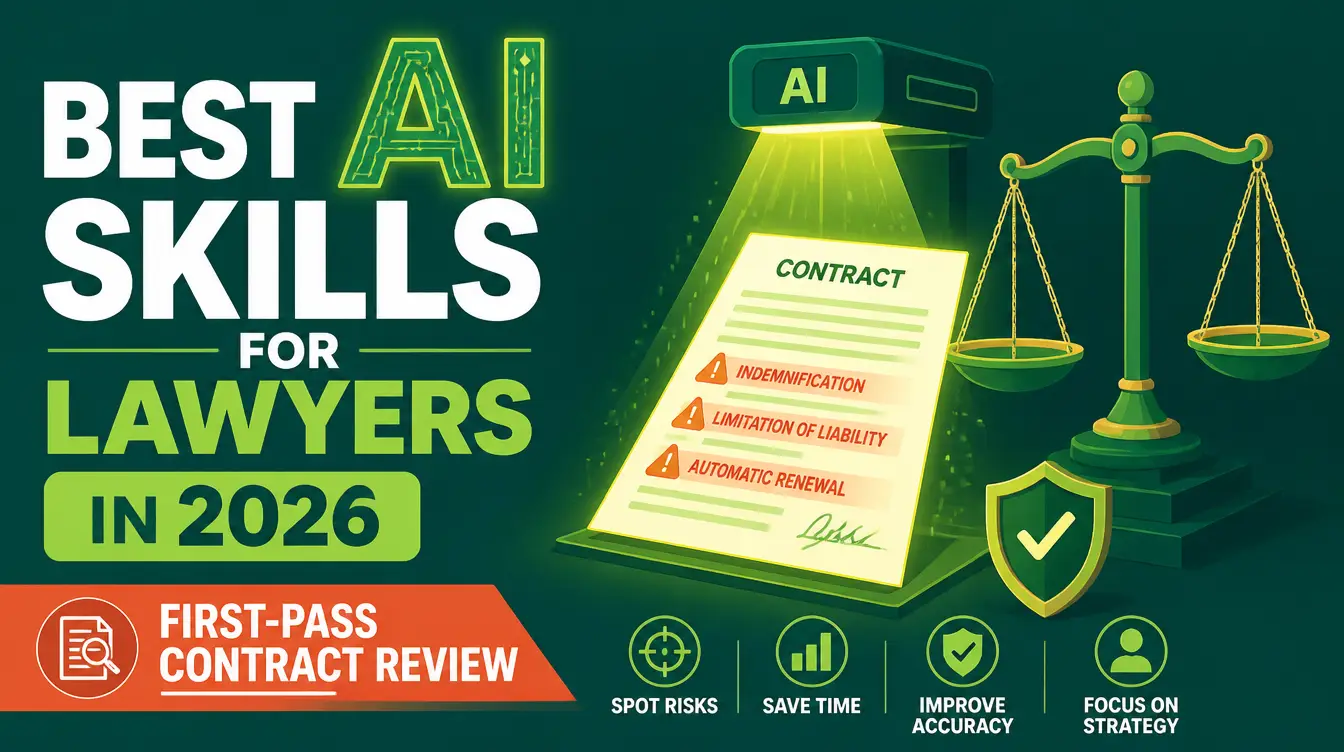
A law practice has a dirty secret: plenty of contracts get skimmed. Not the ones that end up in litigation — the long tail of NDAs, vendor terms, and routine agreements that cross a busy lawyer's desk at volume. The best AI skills for lawyers in 2026 aim exactly at that long tail: a machine-consistent first pass on every document, so professional attention lands where the risk actually lives. None of this replaces legal judgment — it redistributes the hours. And every skill in this stack is free.
The general contract-review workflow is covered in how to review a contract with AI; this article is the legal-practice view of the same tooling, plus two skills most lawyers overlook.
How does the AI Contract Reviewer fit a law practice?
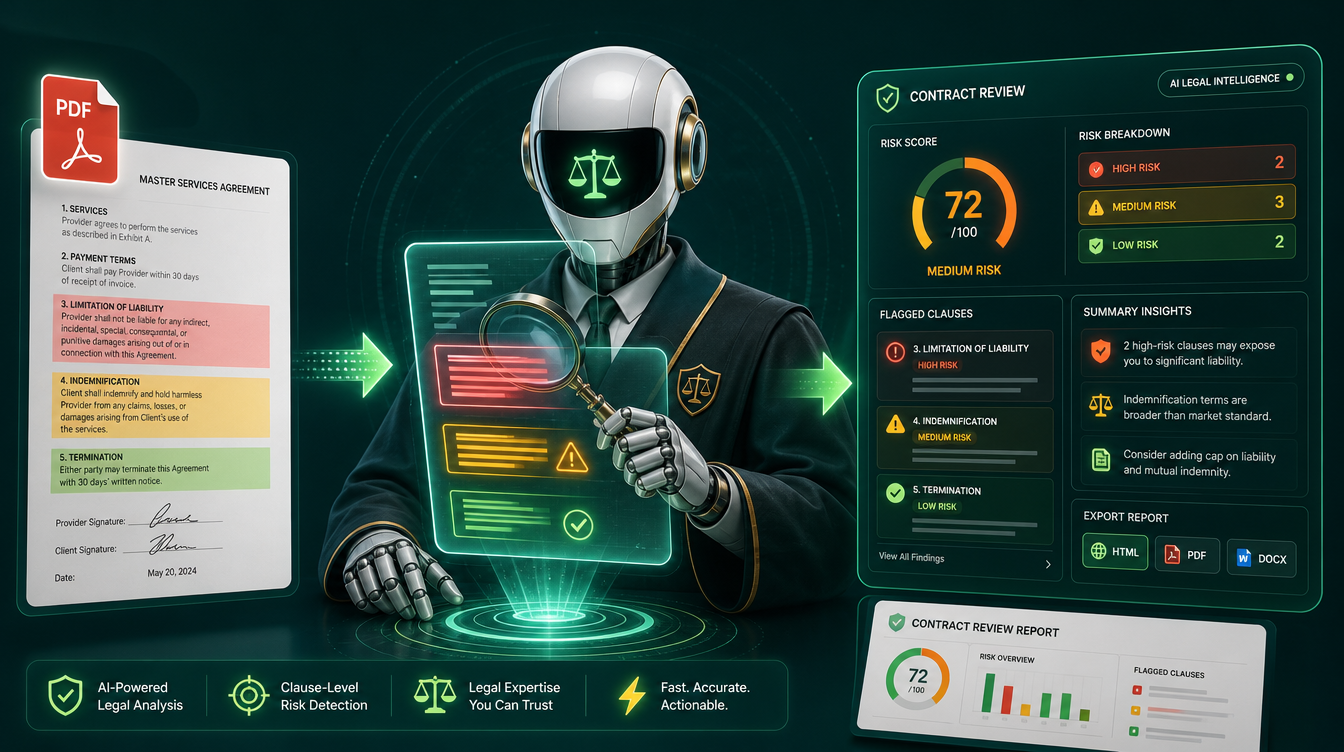
As intake triage. The skill analyzes contracts in Arabic or English, scores every clause from 1 to 10 by risk, and highlights them color-coded inside the full contract body. It auto-detects the governing law, the contract type, and the role in it — the same clause reads differently for the client than for the counterparty, and the skill knows which side it is reviewing from. The output is a self-contained interactive HTML dashboard: a verdict, the top issues, and a prioritized action checklist. For a firm processing dozens of routine agreements a week, that means every document gets the same disciplined read, and the partner's hour goes to the clauses that scored high — not to finding them.
Does it work across MENA jurisdictions?
The bilingual, governing-law-aware review is built for exactly that mix of Arabic and English paperwork that regional practices live in — Egyptian agreements under Egyptian law, Saudi labor contracts, UAE commercial terms, cross-border deals in English. We covered the Egyptian angle in AI contract review for Egypt. The skill's detection of governing law is a starting point for the lawyer to verify, not a conclusion — the same healthy skepticism you would apply to a junior associate's first draft.
Where do the boundaries sit?
| Task | Skill's role | Lawyer's role |
|---|---|---|
| Routine contract intake | Score every clause, rank issues, draft the checklist | Verify, escalate, advise |
| Governing law and jurisdiction | Detect and surface what the document says | Confirm the analysis fits the forum |
| Client negotiation points | Prioritize the clauses worth contesting | Argue them |
| Final legal opinion | None — by design | Entirely yours |
The right question for a law firm is not "can AI do legal work?" It is "who should read contract number nine of the afternoon — a machine that never tires, or the lawyer billing at your rate?"
What about agencies and legal teams at companies?
The same skill scales down and up: a solo counsel triaging vendor terms, an agency pushing five contracts a week — that volume workflow is mapped in automating contract review for agencies — or a firm standardizing intake across juniors. The consistency is the product: every clause gets the 1-to-10 scoring every single time, which also makes the skill a quietly effective training tool for juniors learning where risk hides.
How do lawyers build the practice itself?
Two ways. The LinkedIn Profile Builder is a multilingual coach — English, Arabic, or both — that rebuilds a profile section by section around a goal: attracting clients, establishing thought leadership, or moving to a new practice area. In markets where referrals start with a search, a bilingual profile doubles the audiences that can find you; the walkthrough is in the LinkedIn Profile Builder article. And behind the scenes, the Excel Generator turns firm operations — matter tracking, billing summaries, deadline calendars — into properly formatted workbooks instead of improvised sheets.


What does the legal stack cost?
All three skills in this article are free on Mahara AI. Paid skills on the platform start at 499 EGP (about $10), there is a 499 EGP per month claim-and-keep subscription, and every purchase carries a 7-day refund.
FAQs
What are the best AI skills for lawyers in 2026?
The AI Contract Reviewer for bilingual first-pass review with 1-10 clause scoring, the LinkedIn Profile Builder for client development in English or Arabic, and the Excel Generator for firm operations — all free on Mahara AI.
Does AI contract review give legal advice?
No. The skill is a triage tool: it scores risk and ranks issues so a lawyer knows where to look first. Verification, escalation, advice, and the final opinion remain the lawyer's work — the dashboard just makes the first pass consistent.
Can the skill handle Arabic contracts?
Yes. It analyzes contracts in Arabic or English and auto-detects the governing law, the contract type, and the role in the agreement before scoring — built for the mixed Arabic-English paperwork of MENA practices.
How does clause scoring work?
Every clause is scored from 1 to 10 by risk and highlighted color-coded in the full contract body. The interactive dashboard then presents the verdict, the top issues, and a prioritized action checklist.
How much do the skills cost?
The three skills named here are free on Mahara AI. Paid skills on the platform start at 499 EGP (about $10), with a 499 EGP per month claim-and-keep subscription and a 7-day refund on every purchase.
Your practice will never run out of contracts — only hours. Browse the Mahara AI skills library and put a tireless first-pass reviewer on intake duty.