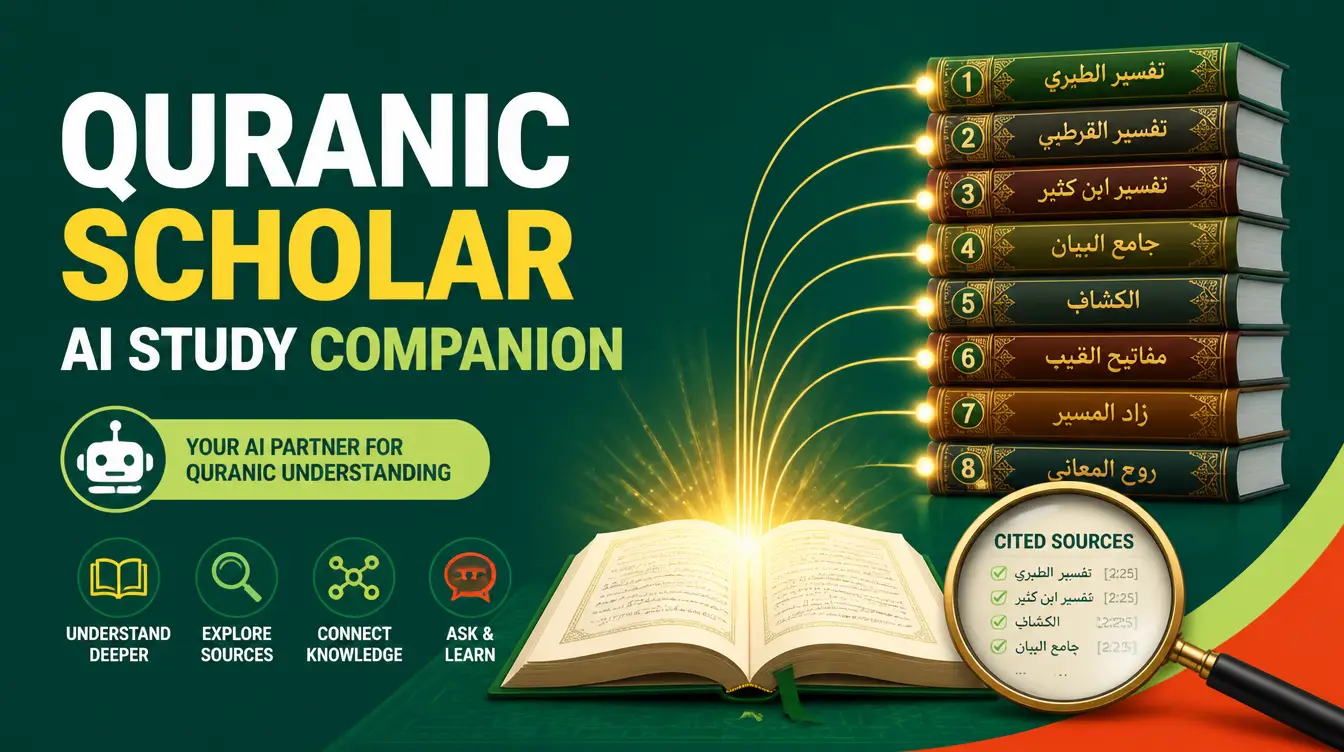
Studying the Quran seriously has always meant one thing: going back to the sources. The Quranic Scholar skill brings that discipline into an AI conversation. It is a free AI skill on Mahara AI that works as a scholarly study companion — retrieving verses verbatim and citing exegesis directly from eight authoritative tafsir sources, instead of paraphrasing from memory.
That distinction matters more here than anywhere else. A general chatbot asked about a verse will produce an answer that sounds confident and may or may not be traceable. The Quranic Scholar skill is built the other way around: the citation comes first, and the explanation is anchored to it. If you are new to the concept, an AI skill is a downloadable bundle of instructions that gives an assistant a specific, well-defined capability.
What exactly is the Quranic Scholar skill?
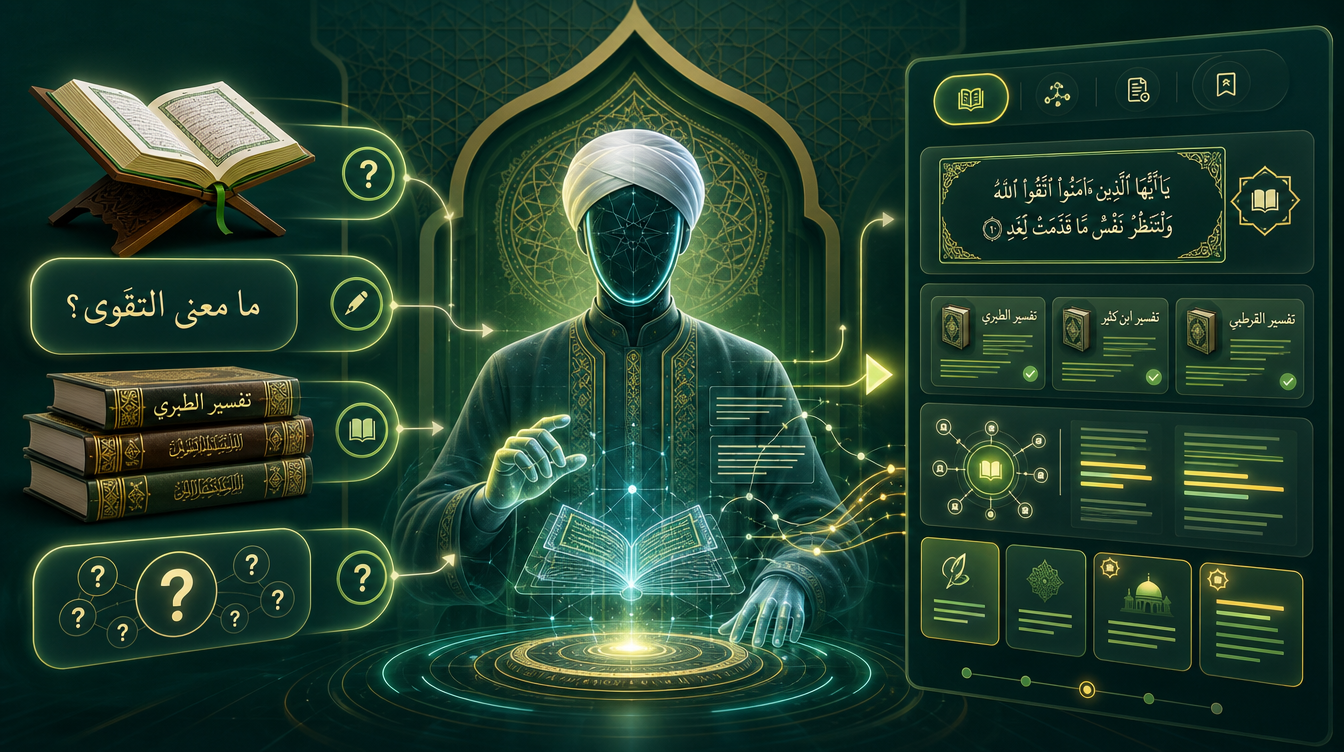
It is a scientific, fully-cited Quranic study assistant powered by the Tafsir MCP server. Rather than generating commentary from training data, it retrieves actual verses and actual exegesis from a connected library of classical and contemporary tafsir works, then presents them with their attribution. You ask a question; it answers with what the sources say, named source by named source.
Which tafsir sources does it draw from?
The skill connects to eight authoritative sources spanning classical and modern scholarship. Among them are Tabari and Ibn Kathir — the two pillars of classical tafsir — alongside Baghawi, Sa'di, the Muyassar, and the Mukhtasar. That spread is deliberate: the classical works preserve the depth of transmitted interpretation, while the later works are valued for clarity and accessibility.
| Source | Known for |
|---|---|
| Tabari | Foundational classical tafsir with transmitted reports |
| Ibn Kathir | The most widely read classical tafsir, hadith-anchored |
| Baghawi | Concise classical compilation of earlier interpretations |
| Sa'di | Modern tafsir prized for its clear, direct language |
| Muyassar & Mukhtasar | Accessible short-form exegesis for quick orientation |
What can you actually ask it?
The skill goes well beyond "what does this verse mean." Its study toolkit includes:
Verbatim verse retrieval, so the text itself is never approximated.
Arabic morphology (I'rab) — the grammatical parsing of words within the verse.
Reasons for revelation (Asbab al-Nuzul) where the sources record them.
Recitation variants (Qira'at) for readers exploring the canonical readings.
Parallel verses — thematically or linguistically related passages across the Quran.
Surah statistics for structural and numerical orientation.
A study companion earns its name by showing its sources. Every answer the Quranic Scholar gives is traceable to a named tafsir — and for matters of religious ruling, a qualified human scholar remains the address.
How is this different from asking a general chatbot?
Three ways. First, sourcing: a general model generates what it statistically remembers; this skill retrieves from a defined library and names where each statement comes from. Second, verbatim accuracy: the verse text comes from the source, not from a probabilistic reconstruction. Third, breadth of apparatus: I'rab, Asbab al-Nuzul, Qira'at, and parallel verses are specialist tools that a generic assistant simply does not structure its answers around. It is the difference between asking someone who read about tafsir and opening the tafsir itself.
Who is it for?
Students of knowledge building a study habit. Teachers preparing a lesson who need sourced material fast. Arabic learners working through morphology. And any reader who has finished a page of the Quran and thought: I want to know what the scholars said about this — without a shelf of volumes within reach. It is one of several values-first free skills in the library, alongside practical ones like the free AI skills you can download today.

How do you start using it?
Download the skill from Mahara AI — it is free — and load it into your assistant following our step-by-step download guide. Then begin the way good study always begins: with a verse and a sincere question.
FAQs
What is the Quranic Scholar skill?
A free AI skill that works as a fully-cited Quranic study companion, retrieving verbatim verses and exegesis from eight authoritative tafsir sources through the Tafsir MCP server.
Which tafsir sources are included?
Eight authoritative works, among them Tabari, Ibn Kathir, Baghawi, Sa'di, the Muyassar, and the Mukhtasar — spanning classical depth and modern clarity.
Does it only explain verse meanings?
No. It also provides Arabic morphology (I'rab), reasons for revelation (Asbab al-Nuzul), recitation variants (Qira'at), parallel verses, and surah statistics.
Can it replace a qualified scholar?
No. It is a study companion that makes the sources accessible and traceable. Questions of religious ruling belong with qualified scholars who know your context.
Is the Quranic Scholar skill free?
Yes. It is free on Mahara AI — download it, load it into your assistant, and begin with any verse you are studying.
The sources were always the answer. Browse the Mahara AI skills library and let the Quranic Scholar put eight of them inside your next study session.